zur deutschen Version, Flagge klicken oder tippen

- historische Region in Frankreich
- former Duchy of Brittany
- own names: French: Bretagne, Breton: Breizh
- former names: Armorica, Aremorica, Britannia minor, Britannia cismarina
• Flag
• Historical Flags
• Meaning/Origin of the Flag
• Coat of Arms
• Meaning/Origin of the Coat of Arms
• Map of the historical Regions in France
• Explanations about the Regions
• Numbers and Facts
• History
• Origin of the Country's Name

Flag of Brittany
– Drapeau de la Bretagne,
→ "Gwenn ha Du",
Source, by:
Wikipedia (DE)



historical flag of Brittany
– Drapeau historique de la Bretagne,
→ "Hermine",
Source, by:
Wikipedia (DE)

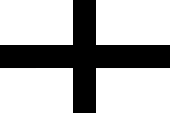
historical flag of Brittany
– Drapeau historique de la Bretagne,
→ "Kroaz Du",
Source, by:
Wikipedia (DE)
from ca. 1920,
Unofficial flag of the Brittany Region
– Drapeau officieux de la région Bretagne,
Source, by:
Wikipedia (D)
The historic flag of Brittany was a scutcheon-flag. It showed the image of the historic coat of arms. The current unofficial flag of Brittany is a creation of modern times. It was in the twenties of the 20th Century when the architect Morvan Marchal created it. The flag shows nine stripes in black and white and a white top corner with black ermine pattern. The design of the today's flag is probably inspired by the flag of the United States. It is called by the Bretons "Gwenn ha Du", what means translated from Breton "White and Black". Black and White are regarded as the Celtic national colors. They are also used in other Celtic regions, e.g. in Cornwall, and also the flag of Scotland should probably have these colours in the beginning. But the reason for the colours black and white for Brittany is to find in the ermine pattern. The ermine pattern is very old and goes back to the Count Pierre Mauclerc of Dreux, who became the Duke of Brittany in 1213. From the 14th century are flags known which showed the black ermine pattern on white, and from the 15th century are known, white flags with a black bar cross. The cross flags were primarily used in the military and for maritime use, which can be explained by improved visibility and ease of manufacture. This cross flag is now interpreted as a colours reversal of the flag of Saint Piran – the flag of Cornwall – and is now interpreted as the true flag of Brittany. It is called by the Bretons "Kroaz Du", what means translated from Breton "Black Cross".
Source:
Volker Preuß,
Wikipedia (DE)
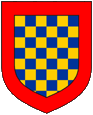
13th century,
original coat of arms of Count Pierre Mauclerc of Dreux
– Armoriaux originales du Comte Pierre Mauclerc de Dreux,
Source, by:
Wikipedia (DE)
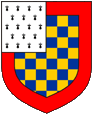
13th century,
Coat of arms of the mature Count Pierre Mauclerc of Dreux
– Armoriaux du Comte mature Pierre Mauclerc de Dreux,
Source, by:
Wikipedia (DE)
1213–1316,
Coat of arms of Brittany
– Armoriaux de la Bretagne,
Source, by:
Wikipedia (DE)
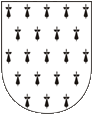
from 1316,
Coat of arms of Brittany
– Armoriaux de la Bretagne,
Source, by:
Wikipedia (DE)
The Duchy of Brittany had until the 13th century probably not its own coat of arms. When the Count of Dreux, Pierre Mauclerc, married the last Duchess of Brittany and consequently got Brittany as a fief, and became in this way the Duke of Brittany himself, his coat of arms was adopted as the arms of Brittany. His coat of arms was originally checkerboarded between gold and blue and was further added by a wide red border. The young count originally wanted to become a priest, and he added because that to his coat of arms a with a black ermine pattern decorated silvery (white) top corner, because the ermine was then considered as an attribute of the clergy. At the moment of his marriage with Duchess Alix, the ermine pattern was first transferred to the Brittany. In the year 1316 Duke Johann III. changed the coat of arms of Brittany to a simple ermine shield, like it is used to today.
Source:
Wikipedia (DE)
The historical, French Regions:

in black: governorate and province in 1776,
in red: former county, province oder governorate
Map: Volker Preuß
The provinces (or governorates) that existed until the French Revolution were historically grown entities that had often developed from former fiefdoms of the French crown, historical counties and duchies, often existed for hundreds of years and had preserved regional characteristics (cultural peculiarities and regional languages). Such phenomena were naturally undesirable to the French Revolution, and in the context of its bloody and violent egalitarianism, all regional references were eradicated. Shortly after the Revolution, the provinces were dissolved and France was divided into many small départements, which were to be approximately the same size and have the same status, controlled by prefects of the central administration in Paris. The departments were named after rivers or mountains so as not to use the names of any of the old provinces. However, it was not possible to sever the ties between the inhabitants of France and their respective historically grown regions, so that in 1960 regions were created again. There can hardly be said to be any real autonomy. The regions are only supposed to promote the economic, social, health, cultural and scientific development of the region, keep an eye on housing and living conditions, and provide support in some areas, e.g. urban development policy, urban regeneration, regional planning, preservation of regional identity and promotion of regional languages. When the regions were formed, departments located in a particular historical province were administratively grouped together into a region that often had the same historical name. The resulting entities only roughly corresponded to the boundaries of historical provinces. In strictly centralised France, however, any form of responsible regionalism is avoided. The regions do not even have their own seals with which to mark their own legally binding decisions, because there are no plans to introduce such a thing. Therefore, anything to do with coats of arms or flags is completely irrelevant. The logos of the regions are used generally, sometimes with the colours reversed and placed arbitrarily on flags or banners. There are no rules, as they are not official symbols. The logos and flags of the regions therefore often look like company logos: Unloving, unhistorical, technocratic and modernistic. That is why most of these regions have a kind of unofficial heraldic flag, which is intended to recall historical heraldic models. However, these are merely decorative in nature and are not a symbol of sovereign functions. The regions created in 1960 were even called into question in 2014, and a territorial reform was decided – centrally from Paris – which reduced the number of regions by almost half through mergers. The regions and their institutions were not even consulted on this matter.
Wikipedia Link to the regions of France:
click or tap here
FOTW Link to the regions of France:
click or tap here
Source: Flags of the World,
Wikipedia (D),
Volker Preuß
The historical Province of Brittany is the today's some smaller Region of Brittany:
Area: 10.582 sq.mi.
Inhabitants: 3.335.414 (2018), thereof 8% speakers of the Breton language
Religions: mostly Catholics and Non-religious
Density of Population: 315 inh./sq.mi.
Capital: Rennes, 217.728 inh. (2018)
official Language: French
other Languages: regional Languages: e.g. Breton, Gallo
Time Zone: GMT + 1 h
Source:
Wikipedia (DE)
antiquity · settlement by many small Celtic tribes, the largest of them are the Veneti and Armoricans, the country is called Armorica (Aremorica)
57–56 B.C. · conquest of Armorica by the Romans, the country comes to the province of Gallia Lugdunensis
5th century A.D. · establishing of the Covenant of Armorica to protect against Germanic invasions, potent immigration of British (Britons, Bretons) from England, who were expelled by the Angles, Saxons and Jutes, Armorica becomes 'Britannia minor' or 'Britannia cismarina' (later also Brittany), the Franks conquer all of Gaul, Brittany comes after the fall of the Western Roman Empire under loose Frankish suzerainty
8th century A.D. · establishing of a Frankish Margraviate of Brittany in the area of the border to the Frankish Empire
861 · Charles the Bald, King of Franconia, hands over the Brittany to Robert the Brave of Anjou, and the territory between the Seine and Loire rivers is elevated to a duchy
880 · Treaty of Verdun and Ribbemont, at the division of the Frankish Empire comes the Brittany formally to the West Frankish Kingdom (France)
10th century · invasions of the Normans
907 · death of Alain the Great, the Brittany is divided into four counties
912 · Charles the Fool of France marries his daughter Gisela with Rollo, the Duke of the Normans, who becomes the Duke of Normandy as Robert I., an he gets Brittany as a fief
1171 · with Conan IV. extincts the dynasty of the dukes, Brittany falls by inheritance to the husband of Constance, the daughter of Conan, namely Gottfried, son of Henry II. of England
1202 · Arthur, son and heir of Henry II. of England is murdered, Brittany is bone of contention between England and France
1213 · Count Pierre Mauclerc von Dreux merrys Alix, the Duchess of Brittany, daughter of Constance, and receives the Brittany as a French fief
1341–1364 · War of Succession
1488 · death of Francis II., the Dukes of Brittany extinct, the legacy goes to his daughter Anna
1491 · Anna is married to King Charles VIII. of France
1499 · Anna is married to Louis XII . of France
1514 · Claude, the daughter of Anna, is married to the Duke of Angoulême
1515 · the Duke of Angoulême becomes King of France as Francis I.
1532 · Brittany is annexed to France, the degrees get promised the preservation of their ancient rights, and maintains until the French Revolution of 1789 inter alia an own parliament
1776 · the already in the 14th century created governorates of the civil administration of the kingdom of France become committed to a number of 39, and correspond in this way to the number of provinces, in previous years could any provinces be summarized in one governorate
1789 · the French Revolution can only prevail with difficulties and with a revolutionary war in Brittany, the estates-state of Brittany and its associated privileges were abolished and the entire region was divided into departments
1960 · reintroduction of regions in France, formation of the Region of Brittany, but not within the historic boundaries, just by integrating the departments of Finistére, Côtes-du-Nord, Morbihan und Ille-et-Vilaine
Source:
Atlas zur Geschichte,
Meyers Konversationslexikon,
Taschenatlas Weltgeschichte
Before the arrival of the British, who fled in the 5th century from the Angles, Saxons and Jutes from Britain, the region was called Armorica (or Aremorica), which means "land by the Sea", and goes even back to the then here living Celtic tribe of the Armoricans. After the arrival of the British the name Armorica was changed to 'Britannia minor' or 'Britannia cismarina', and under French influence the name later changed to 'Bretagne'. Nevertheless, the still here living Celtic Bretons call their country "Breizh".
Source:
Volker Preuß,
Wikipedia (DE),
Meyers Konversationslexikon