zur deutschen Version, Flagge klicken oder tippen

- historical region in today's France
- former Duchy of Normandy
- own name in French: Normandie
- own name in Norman: Normaundie
• Flags
• Meaning/Origin of the Flag
• Coat of Arms
• Meaning/Origin of the Coat of Arms
• Map of the historical Regions in France
• Explanations about the Regions
• Numbers and Facts
• History
• Origin of the Country's Name
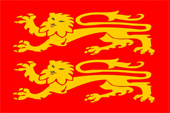
Flag of Normandy
- Drapeau de Normandie,
Source, by: Wikipedia (D)


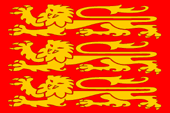
Flag of Normandy as a variant with three leopards
- Drapeau de Normandie comme une variante avec trois léopards,
Source, by: Wikipedia (D)
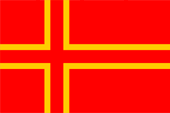
Flag of Normandy with cross of St. Olav
- Drapeau de la Normandie avec la croix de St. Olav,
Source, by: Wikipedia (D)
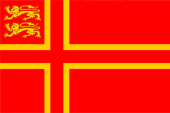
Flag of Normandy with cross of St. Olav and two leopards
- Drapeau de la Normandie avec la croix de St. Olav et deux léopards,
Source, by: Wikipedia (D)

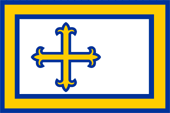
The lengendary flag of William the Conqueror
- le drapeau légendaire de Guillaume le Conquérant,
Source, by: Wikipedia (D)
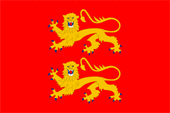
1960–2016,
Unofficial flag of Lower Normandy
- drapeau officieux de la région Basse Normandie,
Source, by: Wikipedia (D)
1960–2016,
Unofficial flag of Upper Normandy
- drapeau officieux de la région Haute Normandie,
Source, by: Wikipedia (D)

1960–2016,
Unofficial flag of Upper Normandy
- drapeau officieux de la région Haute Normandie,
-Variant-
Source, by: www.emblemes.free.fr

The historic flag of Normandy was a scutcheon-flag. It showed the image of the historic coat of arms. The between 1960 and 2016 existing Regions of Upper Normandy and lower Normandy, use both – probably and unofficially without doubt – also the flag with the two lions that supposedly differ only in the form of the lions. But that is not safe, because even in the Upper Normandy are flags in use, which show the three lions (treis cats). The flag of Normandie is usually a scutcheon-flag, it shows the image of the coat of arms: Two golden leopards on red ground. This heraldry goes back to the year 1194. In Normandy there is a flag dispute since the 20s of the 20th century, which manifests itself in the fact, that a version of the flag is used with three leopards, which goes back to the coat of arms of 1189. Some Normans, reject the flag with the two leopards, because the introduction of the coat of arms with the two leopards time roughly coincides with the conquest by France, and because the three leopards remember the Norman kingship, which ruled in England since 1066. To overcome the dispute, in the middle of the 70s of the 19th century a new flag was proposed. It shows on a red background, in Scandinavian design, the cross of St. Olav. He had been baptized in Rouen - the capital of Normandy. However, this flag did not achieve everywhere, it is even locally in the upper quadrant added by two leopards. William II., the Conqueror, Duke of Normandy and from 1066 also King of England, should even had its own flag, when he conquered England. It is few times reproduced on the Bayeux Tapestry. William should have been awarded this banner by Pope Alexander II. for his protection.
Source:
Volker Preuß,
Wikipedia (FR),
Wikipedia (D)
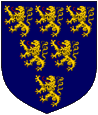
12th century,
Coat of arms of Normandy,
Source, by: Wikipedia (D)
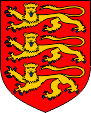
1189 – 1194,
Coat of arms of Normandy,
Source, by: Wikipedia (D)
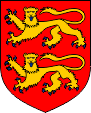
since 1194,
Coat of arms of Normandy,
Source, by: Wikipedia (D)
The first coat of arms of Normandy was the mid-12th Century introduced under the reign of Geoffrey Plantagenet. It was six golden lions on a blue background. When Richard I. (the Lionheart) in 1189 became Duke of Normandy and King of England, his coat of arms with the three golden leopards on red was transferred to the Normandy. From 1194 the coat of arms with the three leopards, however, was adopted as the emblem of the English kingship, and the Normandy had therefore had to cede one of the three leopards.
Source:
Wikipedia (D)
The historical, French Regions:

in black: governorate and province in 1776,
in red: former county, province oder governorate
Map: Volker Preuß
The provinces (or governorates) that existed until the French Revolution were historically grown entities that had often developed from former fiefdoms of the French crown, historical counties and duchies, often existed for hundreds of years and had preserved regional characteristics (cultural peculiarities and regional languages). Such phenomena were naturally undesirable to the French Revolution, and in the context of its bloody and violent egalitarianism, all regional references were eradicated. Shortly after the Revolution, the provinces were dissolved and France was divided into many small départements, which were to be approximately the same size and have the same status, controlled by prefects of the central administration in Paris. The departments were named after rivers or mountains so as not to use the names of any of the old provinces. However, it was not possible to sever the ties between the inhabitants of France and their respective historically grown regions, so that in 1960 regions were created again. There can hardly be said to be any real autonomy. The regions are only supposed to promote the economic, social, health, cultural and scientific development of the region, keep an eye on housing and living conditions, and provide support in some areas, e.g. urban development policy, urban regeneration, regional planning, preservation of regional identity and promotion of regional languages. When the regions were formed, departments located in a particular historical province were administratively grouped together into a region that often had the same historical name. The resulting entities only roughly corresponded to the boundaries of historical provinces. In strictly centralised France, however, any form of responsible regionalism is avoided. The regions do not even have their own seals with which to mark their own legally binding decisions, because there are no plans to introduce such a thing. Therefore, anything to do with coats of arms or flags is completely irrelevant. The logos of the regions are used generally, sometimes with the colours reversed and placed arbitrarily on flags or banners. There are no rules, as they are not official symbols. The logos and flags of the regions therefore often look like company logos: Unloving, unhistorical, technocratic and modernistic. That is why most of these regions have a kind of unofficial heraldic flag, which is intended to recall historical heraldic models. However, these are merely decorative in nature and are not a symbol of sovereign functions. The regions created in 1960 were even called into question in 2014, and a territorial reform was decided – centrally from Paris – which reduced the number of regions by almost half through mergers. The regions and their institutions were not even consulted on this matter.
Wikipedia Link to the regions of France:
click or tap here
FOTW Link to the regions of France:
click or tap here
Source: Flags of the World,
Wikipedia (D),
Volker Preuß
The historical province of Normandy was divided into two regions between 1960 and 2016:
• Basse-Normandie (Lower Normandy) and
• Haute-Normandie (Upper Normandy)
Area: 11.640 sq.mi.
Inhabitants: 3.327.477 (2018)
Density of Population: 286 inh./sq.mi.
Capital: Rouen, 111.360 inh. (2018)
Languages: French, Norman
Time Zone: GMT + 1h
Source: Wikipedia (D)
antiquity · settlement by Celtic tribes, the largest of them are the Kaleters and Venellers
56 B.C. · Roman conquest, to the province of Gallia Lugdunensis
5th century A.D. · the west of the country joins the Federation of Armorica to find protection against Germanic invasions, the east of the country was conquered by the Franks
880 · Treaty of Verdun and Ribbemont, at the division of the Frankish Empire comes the today's Normandy formally to the West Frankish Kingdom (France)
886–911 · the Normans conquer the territory of the today's Normandy
912 · Charles the Simple, King of France, marries his daughter Gisela with Rollo, Duke of the Normans, who gets, as as Robert I., the title of the Duke of the Normandy and even the Brittany as a fief
942 · beginning of the reign of Richard I. , grandson of Robert I., defence of French and Anglo-Saxon attacks
1035 · beginning of the reign Wilhelm II., the conqueror, grandson of Richard I., he can claim his possession of Normandy and supported the Anglo-Saxon King Edward against the Danes, and shall have the Heritage for that
1066 · William II. defeats the Anglo-Saxon King Harold at Hastings and gets proclaimed as king of England
1087 · death of William II., his eldest son, Robert II., becomes Duke of Normandy, his youngest son, Henry I., becomes King of England
1101 · Robert II. comes back from the Crusades and claimes also the crown of England for himself
1106 · Henry invades Normandy and defeats Robert at Tinchebrai and unites Normandy and England under his crown
1135 · death of Henry I., his son Geoffrey Plantagenet, Count of Anjou, becomes Duke of the Normandy, however, already the King of France, Louis VI., had given the Normandy as a fief to Count Stephen of Blois, a nephew of King Henry I.
1144 · Geoffrey Plantagenet establishes finally its rule as Duke of Normandy
1150 · Henry II., son of Geoffrey Plantagenet, becomes is Duke of Normandy
1154 · Henry II., becomes also King of England
1189 · Richard I. (Lionheart) becomes King of England and Duke of the Normandy
1204 · the French King Philip Augustus claimes the Normandy and occupies the country, in the following years fights between France and England for Normandy
1259 · the English King Henry III., cedes the Normandy at the King of France, Saint Louis
1315 · Louis X., King of France, passes the 'Charte Normande', the Duchy maintains its own jurisdiction and constitutional law
1346 · Edward III., King of England, conquers Normandy
1417–1419 · Hundred Years' War, Henry V., King of England, conquers and occupies the Normandy temporarily
1450 · Charles VII., King of France, brings the Normandy finally to France, the heirs of the throne of France wore henceforth the title 'Duke of Normandy', The Normandy becomes later a governorate (province)
1776 · the already in the 14th century created governorates of the civil administration of the kingdom of France become committed to a number of 39, and correspond in this way to the number of provinces, in previous years could any provinces be summarized in one governorate
1789 · French Revolution , the governorates (provinces) become abolished, the Normandy is divided into departments
1960 · reintroduction of regions in France, however, none unified Normandy and not within historical boundaries, but formation of the Regions of Upper Normandy and Lower Normandy, just by integrating the departments of Manche, Calvados and Orne (Lower Normandy), further Seine-Inférieure and Eure (Upper Normandy)
2016 · the Upper Normandy (Haute-Normandie) and Lower Normandy (Basse-Normandie) regions merge in the new, larger region of Normandy (Normandie, capital: Rouen)
Source:
Wikipedia (D),
Atlas zur Geschichte,
Meyers Konversationslexikon,
Taschenatlas Weltgeschichte
The name of the Country "Normandy" goes back to the Normans, which settled here at the end of the 10th century, and their descendants live here until today and maintain their own language and culture.
Source:
Volker Preuß