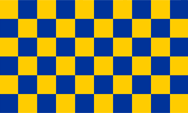
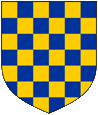
The provinces (or governorates) that existed until the French Revolution were historically grown entities that had often developed from former fiefdoms of the French crown, historical counties and duchies, often existed for hundreds of years and had preserved regional characteristics (cultural peculiarities and regional languages). Such phenomena were naturally undesirable to the French Revolution, and in the context of its bloody and violent egalitarianism, all regional references were eradicated. Shortly after the Revolution, the provinces were dissolved and France was divided into many small départements, which were to be approximately the same size and have the same status, controlled by prefects of the central administration in Paris. The departments were named after rivers or mountains so as not to use the names of any of the old provinces. However, it was not possible to sever the ties between the inhabitants of France and their respective historically grown regions, so that in 1960 regions were created again. There can hardly be said to be any real autonomy. The regions are only supposed to promote the economic, social, health, cultural and scientific development of the region, keep an eye on housing and living conditions, and provide support in some areas, e.g. urban development policy, urban regeneration, regional planning, preservation of regional identity and promotion of regional languages. When the regions were formed, departments located in a particular historical province were administratively grouped together into a region that often had the same historical name. The resulting entities only roughly corresponded to the boundaries of historical provinces. In strictly centralised France, however, any form of responsible regionalism is avoided. The regions do not even have their own seals with which to mark their own legally binding decisions, because there are no plans to introduce such a thing. Therefore, anything to do with coats of arms or flags is completely irrelevant. The logos of the regions are used generally, sometimes with the colours reversed and placed arbitrarily on flags or banners. There are no rules, as they are not official symbols. The logos and flags of the regions therefore often look like company logos: Unloving, unhistorical, technocratic and modernistic. That is why most of these regions have a kind of unofficial heraldic flag, which is intended to recall historical heraldic models. However, these are merely decorative in nature and are not a symbol of sovereign functions. The regions created in 1960 were even called into question in 2014, and a territorial reform was decided – centrally from Paris – which reduced the number of regions by almost half through mergers. The regions and their institutions were not even consulted on this matter.
antiquity · settlement by the Celtic tribe of the Viromands
55 B.C. · Roman conquest
3rd century A.D. · settlement by Franks
481–843 · to the Frankish Empire
9th century · formation of the Viromandesian County (Latin: comitatus viromandensis), as fiefdom under the rule of the descendants of Count Bernhard of of the line of the Earlier Carolingians
880 · Treaty of Verdun and Ribbemont, at the division of the Frankish Empire the Viromandesian County comes to the West Frankish Kingdom (France)
902 · Count Heribert I. was murdered by order of the Count of Flanders
902–943 · reign of Heribert II., son of Heribert I., expansion and extension of the reign, imprisonment of the King of France (Charles the Simple)
946 · the Champagne, now consisting of the Counties of Troyes and Meaux, is given as a fief to the Counts of Vermandois (to 1019)
1076 · Heribert IV. receives by marriage with the heiress of Count Rudolf III. the County of Valois
ca 1077 · death of Heribert IV., the legacy comes through his daughter's (Adélaide) marriage to Hugo, the brother of the French King Philip I, out of the House of Capet
1102 · death of Hugo of Vermandois in Tarsus, the inheritance goes to the son Count Rudolf I. (Raoul), who married Alix of Guyenne, the sister of Eleanor of Aquitaine, rule until 1152 , he leaves three children: Raoul II. (Count from 1152 to 1167), Eleonore, and Mabile, who ruled over the counties of Vermandois, Valois and Amiens between 1167 and 1183 together with her husband Philip of Alsace
1183–1191 · reign of Count Philip of Alsace
1191 · death of Philip, the inheritance goes to Eleanor, the French King takes over Western Vermandois, Eleanor receives as Countess of Saint-Quentin the Eastern Vermandois
1214 · Eleonore waives in favor of the French King, the county falls entirely to the crown
1576 · Vermandois is conveyed to a duchy
1683 · death of Louis of Bourbon (son of Louis XIV.), the title of the Duke of Vermandois extincts, the fief goes to the family of Bourbon-Conde, the country is later connected to the royal province of Picardy
The name "Vermandois" goes back to the Celtic tribe of the Viromands, who formerly lived here. In the 9th century was formed the Viromandesian County (Latin: comitatus viromandensis), the name was later shortened to "Vermandois".