zur deutschen Version, Flagge klicken oder tippen

- historical region in today's France
- former duchy
- own name in German: Elsaß or Elsass, in French: Alsace
• Flags
• Meaning/Origin of the Flag
• Coat of Arms
• Meaning/Origin of the Coat of Arms
• Map of the historical Regions in France
• Explanations about the Regions
• History
• Origin of the Country's Name

Flag of Alsace
– drapeau de Alsace,
Source, by:
biblioweb.hypotheses.org


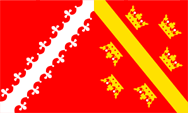
1948-2003,
Unofficial flag of the Alsace Region (1960–2016)
- drapeau officieux de la région Alsace (1960–2016),
Source, by:
Die Welt der Flaggen

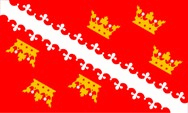
2003–2016,
unofficial flag of the Alsace Region (1960–2016)
- drapeau officieux de la région Alsace (1960–2016),
Source, by:
Wikipedia (D)
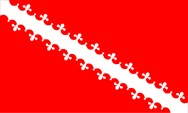
Flag of the Landgraviate of Lower Alsace
- Drapeau du Landgraviat de Basse Alsace

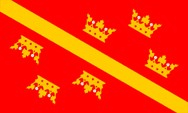
Flag of the Landgraviate of Upper Alsace
- Drapeau du Landgraviat de Haute Alsace

The historic flag of Alsace is a scutcheon-flag, its design from 1948 shows a side-by-side arrangement of the coats of arms of the Landgraviates of Upper Alsace and Lower Alsace. The between 1960 an 2016 existing Region of Alsace used from 20036 an unofficial flag, which combined the features of the flags of Upper Alsace and of Lower Alsace in an other way.
Source:
Volker Preuß,
Wikipedia (D),
biblioweb.hypotheses.org
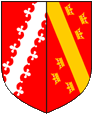
Coat of arms of Alsace
– blason de Alsace,
Source, by:
Heraldique Europeenne
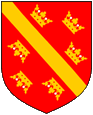
Coat of arms of Upper Alsace
– blason de Haute Alsace,
Source, by:
Heraldique Europeenne
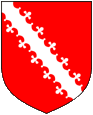
Coat of arms of Lower Alsace
– blason de Basse Alsace,
Source, by:
Heraldique Europeenne
The coat of arms of Alsace is a combination of the coats of arms of the Landgraviates of Upper Alsace and Lower Alsace. Both escutcheons are red, both show an slant right bar, for Upper Alsace, it is golden, for Lower Alsace, it is sivery, but the edges in Lower Alsace show a lily cut. The coat of arms of Upper Alsace shows additionally three golden crowns in the free spaces on both sides of the bar.
Source:
Heraldique Europeenne,
Volker Preuß
The historical, French Regions:

in black: governorate and province in 1776,
in red: former county, province oder governorate
Map: Volker Preuß
The provinces (or governorates) that existed until the French Revolution were historically grown entities that had often developed from former fiefdoms of the French crown, historical counties and duchies, often existed for hundreds of years and had preserved regional characteristics (cultural peculiarities and regional languages). Such phenomena were naturally undesirable to the French Revolution, and in the context of its bloody and violent egalitarianism, all regional references were eradicated. Shortly after the Revolution, the provinces were dissolved and France was divided into many small départements, which were to be approximately the same size and have the same status, controlled by prefects of the central administration in Paris. The departments were named after rivers or mountains so as not to use the names of any of the old provinces. However, it was not possible to sever the ties between the inhabitants of France and their respective historically grown regions, so that in 1960 regions were created again. There can hardly be said to be any real autonomy. The regions are only supposed to promote the economic, social, health, cultural and scientific development of the region, keep an eye on housing and living conditions, and provide support in some areas, e.g. urban development policy, urban regeneration, regional planning, preservation of regional identity and promotion of regional languages. When the regions were formed, departments located in a particular historical province were administratively grouped together into a region that often had the same historical name. The resulting entities only roughly corresponded to the boundaries of historical provinces. In strictly centralised France, however, any form of responsible regionalism is avoided. The regions do not even have their own seals with which to mark their own legally binding decisions, because there are no plans to introduce such a thing. Therefore, anything to do with coats of arms or flags is completely irrelevant. The logos of the regions are used generally, sometimes with the colours reversed and placed arbitrarily on flags or banners. There are no rules, as they are not official symbols. The logos and flags of the regions therefore often look like company logos: Unloving, unhistorical, technocratic and modernistic. That is why most of these regions have a kind of unofficial heraldic flag, which is intended to recall historical heraldic models. However, these are merely decorative in nature and are not a symbol of sovereign functions. The regions created in 1960 were even called into question in 2014, and a territorial reform was decided – centrally from Paris – which reduced the number of regions by almost half through mergers. The regions and their institutions were not even consulted on this matter.
Wikipedia Link to the regions of France:
click or tap here
FOTW Link to the regions of France:
click or tap here
Source: Flags of the World,
Wikipedia (D),
Volker Preuß
1st century B.C. · between Vogesen Mountains and Rhine River settle Germanic tribes (Troboker, Nemeter, Vangiones), in the south also Celts (Sequani, Rauriker)
55 B.C. · Caesar, the Roman general and future dictator conqueres Gaul, as well as the territories of the Germans between the Vogesen Mountains and Rhine River, most become annexed to the Province of Germania Superior
3rd to 5th century A.D. · attacks and invasions of the Alemanni across the Rhine
5th century · the Alemanni settle on both sides of Rhine River
534 · the Franks conquer the territory of the Alemanni, the region between the Vogesen Mountains and Rhine River receives the name "Elsass", Christianization
7th century · formation of the Duchy of Elsass under the Frankish king Pippin
814 · death of Charles the Great (King of the Franks and Holy Roman Emperor)
843 · inheritance disputes, Treaty of Wirten (Verdun), the Frankish kingdom is divided among the three grandsons of Charles the Great, Elsass comes to Lothair I.
870 · Treaty of Meersen, Elsass comes to the realm of Ludwig II.
879/880 · Treaties of Wirten (Verdun) and Ribemont, Elsass comes to the kingdom of Louis III., the Eastern Frankish Empire
10th to 12th century · Elsass belongs in the German Empire to the Duchy of Swabia
12th century · Elsass becomes divided into small principalities and landgraviates, which are directly subordinated to the German King and Emperor, as well as in urban areas (later imperial cities), the Landgraviate of Upper Elsass (Southern Elsass, Sundgau) comes to the Counts of Habsburg, the Landgraviate of Lower Elsass (Northern Elsass) comes to the Counts of Oettingen
1365–1375 · invasion of looting, marauding, French soldiers
14th century · the power of the Counts of Oettingen expires, many territories are sold to the Diocese of Strassburg
1444 · French troops occupy Upper Elsass (Elsass in French = Alsace)
1445 · French troops attack Strassburg and Muehlhausen
1469–1477 · Charles the Bold de Valois, Duke of Burgundy leases the Habsburg possessions in Upper Alsace, but gets fierce resistance of Alsatians, he fall in 1477 in the Battle of Nanzig (Nancy)
1523–1529 · expansion of the Lutheran reformation
1552 · King Henry II. of France seizes the Bishoprics of Metz, Toul and Verdun
1617 · the Habsburg possessions in Upper Alsace come to the Spanish line of the Habsburgs
1648 · end of the 30-years War, Peace of Westphalia, France gets awarded the Spanish possessions in Upper Alsace
17th to 18th century · France wins step for step the supremacy in Alsace, only the towns of Muehlhausen, Saarwerden and Salm remain in the Holy Roman Empire of German Nation
1776 · the already in the 14th century created governorates of the civil administration of the kingdom of France become committed to a number of 39, and correspond in this way to the number of provinces, in previous years could any provinces be summarized in one governorate
1789 · French Revolution, the governorates (provinces) become abolished, Alsace is divided into departments (essentially Bas-Rhin and Haut-Rhin)
1792–1805 · French revolutionary armies attack the German Empire, France occupies in 1797 all the German territories west of the Rhine
1801 · Peace of Luneville, the Holy Roman Empire of German Nation cedes officially all areas of the left bank of the River Rhine to Napoléon's French Empire
1813 · Battle of Leipzig, Napoléon's defeat, Austrian and Russian troops follow the French trough the Alsace and see resistance in the population
1852 · Louis Napoleon becomes Emperor of France as Napoléon III., onset of a French cultural pressure against the Germans in Alsace, trial to suppress the German language, but the Alsatians can preserve their cultural identity within France
1870–1871 · German-French War, France's defeat, France has to cede Alsace and parts of Lorraine to the German Empire, the Alsatians are not so enthusiastic, affiliation as 'Imperial Province of Alsace-Lorraine' to the German Empire
1871–1873 · direct government by the Federal Council of the German Empire
1874 · first elections to the German parliament, formation of a National Committee for Alsace-Lorraine
1879 · installation of a governor as head of Alsace-Lorraine
1911 · the country gets its own constitution and gets equality among the other German states, first and last election for the parliament (Landtag) of Alsace-Lorraine
1914–1918 · First World War, the western front passes through Upper Alsace
11th of November 1918 · Armistice of Compiègne, Alsace-Lorraine is to vacate by German troops within 15 days, with the withdrawal of the German troops, the Republic of Alsace-Lorraine was proclaimed, but startet to transform into a Soviet Republic, French troops were called in to help, who finished the Soviet Republic
17th–21st of November 1918 · French troops marching in, in Muehlhausen (Mulhouse), Colmar, Metz and Strassburg (Strasbourg)
17th of October in 1919 · dissolution of Alsace-Lorraine by France, 200.000 after 1870 immigrated Germans have to leave the country, after an appeal of the USA it was allowed to return for the half
1919–1940 · French assimilation policy towards the German population causes growing discontent and dissatisfaction
1939–1945 · Second World War, on 19th of June in 1940 the German Wehrmacht occupies Alsace-Lorraine, the country becomes integrated into the German administration and into the NSDAP-districts, but becomes not officially re-annexed to the German Empire, it comes to expulsions of some French out of the country, in 1942 introduce of conscription, conscriptions into the German Wehrmacht and the Waffen-SS, January 1945: Allied troops reach Alsace-Lorraine, re-establishment of the French administration, once more onset of the French policy of assimilation
1960 · reintroduction of regions in France, formation of the Region of Alsace, but not within the historic boundaries, just by integrating of the departments of Bas-Rhin and Haut-Rhin
2016 · the Alsace (Elsass) region merges with the Champagne-Ardenne and Lorraine (Lothringen) regions in the new, larger region of Greater East (Grand Est)
Source:
Meyers Konversationslexikon,
Wikipedia (D),
Atlas zur Geschichte
The origin of the name "Alsace" goes back to the period of the Frankish rule. There are two explanations: The name comes from the word "Elisassen" which means "foreign residents" (sassen = inhabitants), or from the word "Illsassen" what means: "the inhabitants of the banks of the Ill". The Ill (ILL) is a river that flows parallel to the Rhine in central Alsace, and flows into the Rhine 10 km north of Strasbourg. In French the land is called "Alsace".
Source:
Meyers Konversationslexikon