zur deutschen Version, Flagge klicken oder tippen

- French regional authority with special status (collectivité territoriale)
- own name: Corsican: Corsica, French: Corse
• Flag
• Meaning/Origin of the Flag
• Map of the historical Regions in France
• Explanations about the Regions
• Numbers and Facts
• History
• Origin of the Country's Name
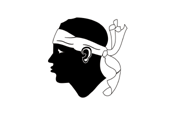
Flag of Corsica
– drapeau de Corse,
Source, by: Die Welt der Flaggen


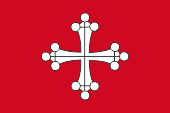
1077–1300,
Flag of Pisa,
Source, by: Wikipedia (IT)
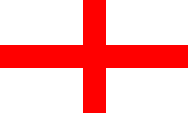
1300–1768,
Flag of Genoa,
Source, by: Wikipedia (IT)
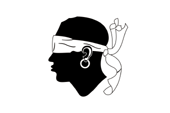
ca. 1400–1755,
Flag of Corsica,
Source, by: Wikipedia (EN)

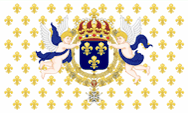
1768–1790,
Flag of France,
Source, by:
Sodacan [CC BY-SA 3.0], via Wikimedia Commons
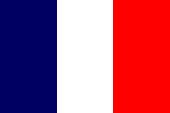
since 1794,
Flag of France,
Source, by: Corel Draw 4
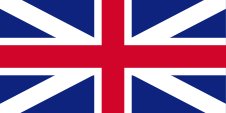
1794–1796,
Flag of United Kingdom,
Source, by: Die Welt der Flaggen

The flag of Corsica, probably dates from the 15th century, is single-coloured white, and shows a Moor's head in the middle. This peculiar symbol is known in Aragón, Corsica and Sardinia. It goes probably back to the Kingdom of Aragón, because this symbolism there has been used since 1096, and in 1297 gave the Pope Sardinia as a fief to King Jacob II. of Aragón. The Moor's heads are the heads of four Moorish kings, who were defeated ad beheaded in the year 1096 at the Battle of Alcoraz by King Peter I. of Aragón. Moor's heads on flags, blindfolded or not, served later as a deterrent. In the early Middle Ages the countries and cities had suffered greatly at the northern edge of the Mediterranean Sea under Moorish pirates who raided, murdering and plundering the coasts and the people abducted into slavery. But how the Moor's head came to Corsica? In the 14th/15th century the possession of the island was the reason for armed conflicts between Genoa, Aragon and local forces. Finally, Corsica became Genoese, however, there have been riots against Genoa again and again, until the island was finally sold to France in 1768. One of these uprisings was supported by Aragón. One in the service of Aragon standing Corsican, Vincentellu d'Istria (1380–1434), was actively involved in the fightings, and he probably brought the Moor's head with the flag of Aragón to the island, and the Moor's head has been adopted as a symbol of freedom. Because of the fact, that the Moor's head was actually seen as a symbol of freedom, he was released in 1755 from the attributes of a prisoner, the blindfold changed to a headband and the ear ring was dispensable. In 1999, after 700 years, the flag of Sardinia was adjusted this style. The Moor's heads got headbands instead of blindfolds, and also the earring was removed. And, however, the four Moors look away from the flag pole since that year.
Source:
www.planet-schule.de
The historical, French Regions:

in black: governorate and province in 1776,
in red: former county, province oder governorate
Map: Volker Preuß
The provinces (or governorates) that existed until the French Revolution were historically grown entities that had often developed from former fiefdoms of the French crown, historical counties and duchies, often existed for hundreds of years and had preserved regional characteristics (cultural peculiarities and regional languages). Such phenomena were naturally undesirable to the French Revolution, and in the context of its bloody and violent egalitarianism, all regional references were eradicated. Shortly after the Revolution, the provinces were dissolved and France was divided into many small départements, which were to be approximately the same size and have the same status, controlled by prefects of the central administration in Paris. The departments were named after rivers or mountains so as not to use the names of any of the old provinces. However, it was not possible to sever the ties between the inhabitants of France and their respective historically grown regions, so that in 1960 regions were created again. There can hardly be said to be any real autonomy. The regions are only supposed to promote the economic, social, health, cultural and scientific development of the region, keep an eye on housing and living conditions, and provide support in some areas, e.g. urban development policy, urban regeneration, regional planning, preservation of regional identity and promotion of regional languages. When the regions were formed, departments located in a particular historical province were administratively grouped together into a region that often had the same historical name. The resulting entities only roughly corresponded to the boundaries of historical provinces. In strictly centralised France, however, any form of responsible regionalism is avoided. The regions do not even have their own seals with which to mark their own legally binding decisions, because there are no plans to introduce such a thing. Therefore, anything to do with coats of arms or flags is completely irrelevant. The logos of the regions are used generally, sometimes with the colours reversed and placed arbitrarily on flags or banners. There are no rules, as they are not official symbols. The logos and flags of the regions therefore often look like company logos: Unloving, unhistorical, technocratic and modernistic. That is why most of these regions have a kind of unofficial heraldic flag, which is intended to recall historical heraldic models. However, these are merely decorative in nature and are not a symbol of sovereign functions. The regions created in 1960 were even called into question in 2014, and a territorial reform was decided – centrally from Paris – which reduced the number of regions by almost half through mergers. The regions and their institutions were not even consulted on this matter.
Wikipedia Link to the regions of France:
click or tap here
FOTW Link to the regions of France:
click or tap here
Source: Flags of the World,
Wikipedia (D),
Volker Preuß
Area: 3.382 square miles
Inhabitants: 338.554 (2018)
Religions: 92% Roman Catholic
Density of Population: 39 inh./sq.mi.
Capital: Ajaccio, 70.817 inh. (2018)
Languages: French, Corsican
Currency: 1 Euro (€) = 100 Cent
Time Zone: GMT – 1
Source:
Wikipedia (D)
antiquity · cettlement by the Ligurian tribe of the Corsicans
544 B.C. · conquest by Carthaginians and Etruscans, to the Carthaginian sphere of influence
238 B.C. · First Punic War, defeat of Carthage against the Roman Empire, Corsica comes to the Roman sphere of influence
231 · annexed to the Roman Empire, to the province of "Corsica et Sardinia"
470 A.D. · invasion of the Vandals
533 · to the Byzantine Empire (East Rome)
6th–7th cent. · invasions of the Goths and Langobards
713 · invasion of the Arabs
754 · conquest by the Franks
833 · the frankish King Louis the Pious gives the island as a fief to the Margrave of Tuscany
1077 · Pope Urban II. gives the island as a fief to Pisa
1217 · troops of Genoa conquer the city of Bonifacio
1284 · Sea-Battle of Melloria, Genoa destroys the Pisan fleet, conquer of the island by Genoa
1300 · Pisa cedes Corsica officially to Genoa
1296 · Pope Boniface VIII. gives Corsica and Sardinia to King James of Aragón as a fief, fights between Corsicans, Genoa and Aragon, finally the island remains at Genoa
1729 · anti-genoese rebellion, fights against Genoese troops on the island
1735 · Corsica declares itself as independent from Genoa
1736 · the in the British service acting German Baron Theodor von Neuhof lands on the island and seizes the power, the Corsicans proclaim him as Theodor I. to the King of Corsica
1737 · conquest by French troops on behalf of Genoa
1746 · Corsica declares itself again as independent from Genoa, one more fights against Genoese troops on the island
15th of May in 1768 · Genoa sells Corsica to France for 40 million Francs, fights against French troops on the island
9th of May in 1769 · battle of Ponte Nuovo, the Corsicans subject to France
1774 · the island is a French province
1793 · fights against French troops on the island
May 1794 · the Corsicans conquer towns of Bastia and Calvi with British aid
18th of June in 1794 · the Corsican assembly deputies proclaim the island as a (Vice-)Kingdom under the rule of United Kingdom
October 1796 · reconquest by French troops, withdrawal of the British troops, reincorporation to France
20th century · immigration of French, the Corsicans become a minority, displacement of the Corsican language out of school and public life, since 1976 armed resistance by the Frontu di Liberation Naziunalista Corsu (FLNC)
2018 · administrative reform, General Council and Regional Council are merged, the country becomes a "Collectivité territoriale unique"
Source:
Meyers Konversationslexikon,
Wikipedia (D),
Atlas zur Geschichte
About the origin of the name of the island exist two theories: 1st) the name of Corsica/Corse goes probably back to the Phoenician word "Korsai", what means translated "covered with forests". 2nd) the name of Corsica/Corse is the Greek name for Kalliste island, what means translated "the beautiful".
Source:
Wikipedia (D)