zur deutschen Version, Flagge klicken oder tippen

- Comitatus Vindascinus, or Comtat Venaissin, or just: Comtat
- historical region in today's France
- former Papal county and former French province
• Flag
• Meaning/Origin of the Flag
• Coat of Arms
• Meaning/Origin of the Coat of Arms
• Map of the historical Regions in France
• Explanations about the Regions
• History
• Origin of the Country's Name

Flag of Venaissin
– drapeau de Venaissin,
Source, by: Die Welt der Flaggen


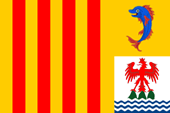
since 1999,
Flag of Provence-Alpes-Côte d’Azur Region
– drapeau de la région Provence-Alpes-Côte d’Azur,
Source, by: Flags of the World


Unofficial flag of Département Vaucluse
– drapeau officieux de la Département Vaucluse,
Source, by: Wikipedia (FR)


The flag of Venaissin is a scutcheon-flag, its design is the image of the coat of arms. The related Heraldry displays a red flag with two crossed golden keys, bound with a blue ribbon. Since 1999 is in the region of "Provence- Alpes-Côte d’Azur" – to which the Venaissin belongs – an unofficial flag in use, which combines the features of the heraldry of the County of Barcelona (Provence belonged from 1112 to 1245 to the County of Barcelona), of the County of Dauphiné and of the County of Nice. In the Département Vaucluse is – probably unofficially – a flag in use, which containes the features of the heraldry of Venaissin. However, there are not both keys are golden, but only one, and the other is tinged with silver, as in the coat of arms of the Vatican.
Source:
Volker Preuß,
Wikipedia (D)

14th century to 1791,
Coat of arms of the County of Venaissin
– Blason du Comte de Venaissin,
Source, by:
Wikipedia (D)

Coat of arms of Avignon
– Blason du Avignon,
Source, by:
Wikipedia (D)
The coat of arms of Venaissin shows a red shield with two crossed golden keys, bound with a blue ribbon. Venaissin was a papal county between 1274 and 1789, a possession of the Holy See, and Avignon was even the seat of the Pope between 1309 and 1377. So it is no wonder that the papal symbolism in the form of the keys of Saint Peter has been included in the coat of arms. But both keys are golden and not one of them tinged in silver, as it is the case with the Vatican's coat of arms.
Source:
Wikipedia (D),
heraldique.org
The historical, French Regions:

in black: governorate and province in 1776,
in red: former county, province oder governorate
Map: Volker Preuß
The provinces (or governorates) that existed until the French Revolution were historically grown entities that had often developed from former fiefdoms of the French crown, historical counties and duchies, often existed for hundreds of years and had preserved regional characteristics (cultural peculiarities and regional languages). Such phenomena were naturally undesirable to the French Revolution, and in the context of its bloody and violent egalitarianism, all regional references were eradicated. Shortly after the Revolution, the provinces were dissolved and France was divided into many small départements, which were to be approximately the same size and have the same status, controlled by prefects of the central administration in Paris. The departments were named after rivers or mountains so as not to use the names of any of the old provinces. However, it was not possible to sever the ties between the inhabitants of France and their respective historically grown regions, so that in 1960 regions were created again. There can hardly be said to be any real autonomy. The regions are only supposed to promote the economic, social, health, cultural and scientific development of the region, keep an eye on housing and living conditions, and provide support in some areas, e.g. urban development policy, urban regeneration, regional planning, preservation of regional identity and promotion of regional languages. When the regions were formed, departments located in a particular historical province were administratively grouped together into a region that often had the same historical name. The resulting entities only roughly corresponded to the boundaries of historical provinces. In strictly centralised France, however, any form of responsible regionalism is avoided. The regions do not even have their own seals with which to mark their own legally binding decisions, because there are no plans to introduce such a thing. Therefore, anything to do with coats of arms or flags is completely irrelevant. The logos of the regions are used generally, sometimes with the colours reversed and placed arbitrarily on flags or banners. There are no rules, as they are not official symbols. The logos and flags of the regions therefore often look like company logos: Unloving, unhistorical, technocratic and modernistic. That is why most of these regions have a kind of unofficial heraldic flag, which is intended to recall historical heraldic models. However, these are merely decorative in nature and are not a symbol of sovereign functions. The regions created in 1960 were even called into question in 2014, and a territorial reform was decided – centrally from Paris – which reduced the number of regions by almost half through mergers. The regions and their institutions were not even consulted on this matter.
Wikipedia Link to the regions of France:
click or tap here
FOTW Link to the regions of France:
click or tap here
Source: Flags of the World,
Wikipedia (D),
Volker Preuß
antiquity · settlement by Celtic tribes, the largest of them are the Cavarers
58 B.C. · Roman conquest, the area comes to the province of Gallia Narbonensis
52 B.C. · an uprising of the Gauls under Vercingetorix is suppressed
4th/5th century A.D. · the Burgundians come from the region between the Oder River and Vistula River and invade into the Roman Empire, settle on the Middle Rhine near Worms and plunder neighboring Roman settlement areas
436 · the Kingdom of Burgundy in the Middle Rhine area is shattered by Huns in Roman service
443 · the surviving Burgundians get settled by the Romans in the area of Lake Geneva and the today's Savoy
443–500 · establishing of the Kingdom of Burgundy (Burgundia), territorial expansions
534 · conquest of the Kingdom of Burgundy by the Franks, today's Burgundy comes to the Frankish Empire, the area will remain as part of empire with its own administration
870 · at the division of the Frankish Empire (Treaty of Meersen) arises the West Frankish Kingdom, the East Frankish Kingdom, and the Frankish Kingdom of Italy – Burgundy gets divided, the north (Upper Burgundy) comes to the West Frankish Kingdom, the south (Lower Burgundy) comes to the Frankish Kingdom of Italy
877 · Lower Burgundy separates from Italy
879 · Boso of Vienne is king of Lower Burgundy
880 · by the division of the Frankish Empire (Treaties of Verdun and Ribbemont) arises the West Frankish Kingdom (later France), the East Frankish Kingdom (later German Empire), the Kingdom of Italy, the Kingdom of Upper Burgundy (under Rudolf the Welf), the Kingdom of Lower Burgundy persists, and formerly Burgundian territories in the northwest come as "Regnum Burgundiae" to the West Frankish Kingdom too
920–1016 · Regnum Burgundiae develops to a duchy of France, which adopts the name of Burgundy (=> Duchy of Burgundy)
951 · Upper Burgundy and Lower Burgundy become united to the Kingdom of Burgundy, under Conrad III. of Upper Burgundy, this country is also called Arelat, there are several formed counties, including the counties of Venaissin and Avignon
965–1019 · rule of the Counts of Provence, Arles and Avignon over the county Venaissin with its capital Venasque
1019 · Emma of Provence, the heiress of Provence, Arles and Avignon gets married with William III. Count of Toulouse, the Venaissin comes thus to the house of Toulouse
1033 · the Kingdom of Burgundy (Arelat) comes as an inheritance to the German Empire, the Roman-German Emperor Conrad the Elder is elected in Peterlingen (Payerne) to the king of Burgundy, but in subsequent years, the country is divided into several counties (County of Provence, County of Venaissin, County of Savoy, County of Dauphiné, Franche-Comté), the last king of Burgundy is the Emperor Charles IV., who was enthroned in 1365
1241 · Joan of Toulouse, the heiress of Toulouse, Provence, Arles and Avignon marries Alfons of Poitiers, the brother of the king of France (Louis I .), these areas and the Venaissin come in this way to the french crown
1274 · the King of France cedes Venaissin to the Pope, which was not brought to a county until years later (under Pope Clement V.), a county of the Papal States, which is locally represented by a Papal Rector
1309 · Avignon is the seat of the Pope
1320 · Carpentras is the capital of Venaissin
1348 · Pope Clement VI. purchases from Countess Johanna of Provence the city and county of Avignon, which is now locally represented by a Papal Vice-Legate
1377 · the seat of the Pope will be moved back to Rome
1663 · invasion of French troops
1668 · invasion of French troops
1768–1774 · Venaissin and Avignon are occupied by French troops
1789 · during the French Revolution there are riots in Venaissin and Avignon too, Avignon calls the connection to France
April 1790 · national estates assembly of Venaissin, the political system is reformed republican, but the supremacy of the Pope is confirmed, however, the Vice-Legate of Avignon flees to Venaissin
14th of September in 1791 · in consequence of a popular uprising and an unauthorized referendum the French Constituent National Assembly decides the affiliation of Venaissin and Avignon to France
19th of September in 1797 · Peace of Tolentino, the Pope cedes Venaissin and Avignon to France, under pressure
1793 · Venaissin , Avignon and Orange are merged to the Department of Vaucluse
1814/15 · Congress of Vienna, reorganization of Europe after the era of Napoleon, the Papal States protest because the former and by Napoléon extorted papal areas of Venaissin and Avignon were not discussed at the congress
1960 · reintroduction of regions in France, the Department of Vaucluse comes to the Region of Provence-Alpes- Côte d' Azur
Source:
Meyers Konversationslexikon,
Wikipedia (D)
The name "Venaissin" goes probably back to Venasque, the old capital of the county. The latin name of the country was Comitatus Vindascinus, the french name was Comtat Venaissin.
Source: Wikipedia (D)