zur deutschen Version, Flagge klicken oder tippen

- historical region in France
- former county
- today part of Orléanais
• Flag
• Meaning/Origin of the Flag
• Coat of Arms
• Meaning/Origin of the Coat of Arms
• Map of the historical Regions in France
• Explanations about the Regions
• History
• Origin of the Country's Name

Flag of Blois – Drapeau de Blois,
Source, by:
Wikipedia (DE)


The flag of Blois is a scutcheon flag. Its design displays the image of the coat of arms of the Counts of Blois.
Source:
Volker Preuß
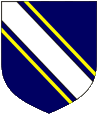
ca. 940–1231, Blois
Coat of arms of the County of Blois
– Drapeau de Comté de Blois,
Source, by:
Wikipedia (DE)
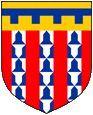
1231–1391, Châtillon
Coat of arms of the Counts of Blois
– blason de Comté de Blois,
Source, by:
By Jimmy44Image created for the Blazon Project of the French Wikipedia [GFDL or CC BY 3.0], via Wikimedia Commons
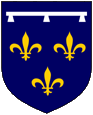
1391–1489, Orléans
Coat of arms of the Counts of Blois
– blason de Comté de Blois,
Source, by:
Wikipedia (D)
The coat of arms of Blois shows a white oblique-right bar on blue ground, which is bounded above and below by golden lines. After the extinction of the Counts of Blois, the county came in 1231 to the House of Châtillon, powerful gentries who were temporarily enfeoffed with several counties, but never ascended to the high nobility. Their coat of arms showed a six-fold clefted shield, between red and blue and white iron helmets, and a golden shield-head, which is added with blue strips for the Counts of Blois. The House of Châtillon sold Blois to the House of Orléans in 1391, who had the title of counts until 1489, as Blois came right to the crown.
Source:
Heraldique Europeenne,
Wikipedia (FR),
Volker Preuß
The historical, French Regions:

in black: governorate and province in 1776,
in red: former county, province oder governorate
Map: Volker Preuß
The provinces (or governorates) that existed until the French Revolution were historically grown entities that had often developed from former fiefdoms of the French crown, historical counties and duchies, often existed for hundreds of years and had preserved regional characteristics (cultural peculiarities and regional languages). Such phenomena were naturally undesirable to the French Revolution, and in the context of its bloody and violent egalitarianism, all regional references were eradicated. Shortly after the Revolution, the provinces were dissolved and France was divided into many small départements, which were to be approximately the same size and have the same status, controlled by prefects of the central administration in Paris. The departments were named after rivers or mountains so as not to use the names of any of the old provinces. However, it was not possible to sever the ties between the inhabitants of France and their respective historically grown regions, so that in 1960 regions were created again. There can hardly be said to be any real autonomy. The regions are only supposed to promote the economic, social, health, cultural and scientific development of the region, keep an eye on housing and living conditions, and provide support in some areas, e.g. urban development policy, urban regeneration, regional planning, preservation of regional identity and promotion of regional languages. When the regions were formed, departments located in a particular historical province were administratively grouped together into a region that often had the same historical name. The resulting entities only roughly corresponded to the boundaries of historical provinces. In strictly centralised France, however, any form of responsible regionalism is avoided. The regions do not even have their own seals with which to mark their own legally binding decisions, because there are no plans to introduce such a thing. Therefore, anything to do with coats of arms or flags is completely irrelevant. The logos of the regions are used generally, sometimes with the colours reversed and placed arbitrarily on flags or banners. There are no rules, as they are not official symbols. The logos and flags of the regions therefore often look like company logos: Unloving, unhistorical, technocratic and modernistic. That is why most of these regions have a kind of unofficial heraldic flag, which is intended to recall historical heraldic models. However, these are merely decorative in nature and are not a symbol of sovereign functions. The regions created in 1960 were even called into question in 2014, and a territorial reform was decided – centrally from Paris – which reduced the number of regions by almost half through mergers. The regions and their institutions were not even consulted on this matter.
Wikipedia Link to the regions of France:
click or tap here
FOTW Link to the regions of France:
click or tap here
Source: Flags of the World,
Wikipedia (D),
Volker Preuß
Antiquity, Romans · the city of Blesae is an important place and becomes in the 9th century the center of the Carolingian County of Blesis (Pagus Blesensis) , the name of the place became transformed in the 15th century to Blaisois, and in modern times to Blois
5th century A.D. · conquest and settlement by the Franks, to the Frankish Empire
880 · Treaty of Verdun and Ribbemont, at the division of the Frankish Empire comes the region to the West Frankish Kingdom (later France)
about 940 · Robert the Brave, Marquis of Neustria, inherits the County of Blois to his son in law , the Viscount of Tours, a Capetian, who becomes the founder of the House of Blois
956/960 · Theobald I. of Blois, seizes the Counties of Chartres and Châteaudun
about 990 · acquisition of the Counties of Beauvais and Dreux by the Counts of Blois as a fief
1019/25 · the Counts of Blois get the Counties of Troyes and Meaux as a fief
1107–1152 · reign of Theobald IV., the Great, from the House of Blois, the Counties of Troyes and Meaux are merged to the County of Champagne
1152 · inheritance, the Champagne comes to the senior line of the House of Blois, the County of Blois comes to the junior line of the House of Blois
1218 · extinction the junior line of the House of Blois
1231 · the legacy of Blois junior line comes by marriage to the Counts of Saint-Pol from the House of Châtillon
1391 · the House of Châtillon solds the County of Blois to Duke Louis of Orléans, son of Charles V., King of France
1462 · the later Louis XII. , King of France, is born in Blois
1498 · Louis XII. , King of France , grandson of Charles V., makes Blois to a component of the Crown of France, Blois becomes the residence and resort of rhe kings and the seat of the imperial estates, comes later to the gouvernorate (province) of Orléanais
1588 · King Henry III. convenes the imperial assembly to Blois, murder of Duke Henry of Guise and execution of his brother, Cardinal Louis de Guise
1610–1643 · reign of King Louis XIII. over France, his brother John Gaston of Orléans resides at Blois
1643–1715 · reign of King Louis XIV. over France, his brother Philip of Orléans resides in Blois
1789 · French Revolution, the governorates (provinces) become abolished, the Orléanais is divided into departments
31st of March in 1814 · allied troops conquer Paris, Empress Marie Louise, wife of Emperor Napoléon I. of France, eludes on 1st of April in 1814 to Blois, on 2nd of April Napoléon was deposed by the Senate and on 6th of April he abdicates
Source:
Wikipedia (D),
Meyers Konversationslexikon
The name "Blois" has its roots in the capital of the county. Already in Romans times the city of Blesae is an important place and becomes in the 9th century the center of the Carolingian County of Blesis (Pagus Blesensis). The name of the place became transformed in the 15th century to Blaisois, and in modern times to Blois.
Source:
Meyers Konversationslexikon,
Volker Preuß