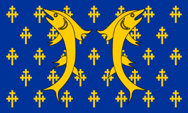
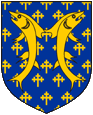
1040–1419, Scarponnois Coat of arms of the House of Scarponnois – Blason de Maison du Scarponnois, Source, by:
wappenwiki.org
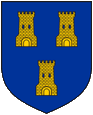
from 1445, Châtenois Coat of arms of the House of Châtenois – Blason de Maison du Châtenois, Source, by:
von Flappiefh, d'après BlackBeast5 (File:COA fr Chatenois Les Forges.svg) [GFDL oder CC BY-SA 3.0], via Wikimedia Commons
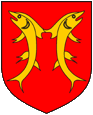
The coat of arms of Bar features a blue shield, sprinkled with little golden crosses and topped with two golden barbs. The origin of the arms is not known. But, the coat of arms goes possibly back to the year 1480, when Duke René II. of Lorraine became Duke of Bar, because it can be interpreted as a heraldic combination of the characteristics of the Houses of Scarponnois (from the 11th to the 15th century counts and dukes of Bar), and Châtenois (from 1445 Dukes of bar), after all, the two golden barbs are (House of Scarponnois) combined with a blue background (House of Châtenois).
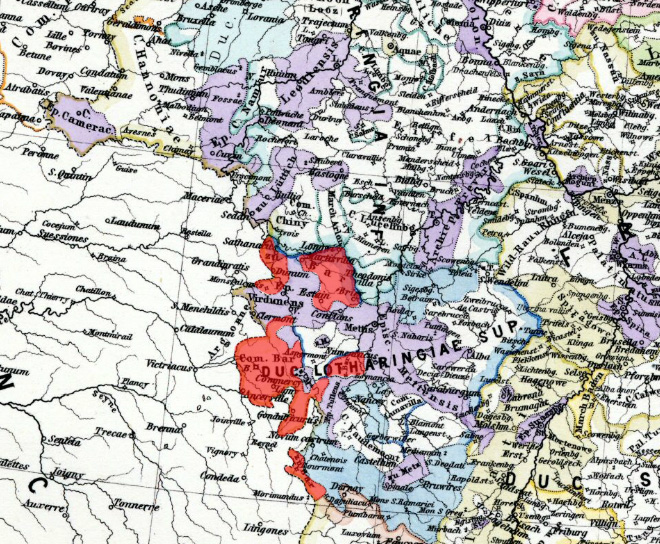
The map shows – at the and of the 13th century – the south of the Duchy of Lower Lorraine (Ducatus Lotharingiae Inferior) and the Duchy of Upper Lorraine (Ducatus Lotharingiae Superior), and, there within, marked with red, the County of Bar.
The provinces (or governorates) that existed until the French Revolution were historically grown entities that had often developed from former fiefdoms of the French crown, historical counties and duchies, often existed for hundreds of years and had preserved regional characteristics (cultural peculiarities and regional languages). Such phenomena were naturally undesirable to the French Revolution, and in the context of its bloody and violent egalitarianism, all regional references were eradicated. Shortly after the Revolution, the provinces were dissolved and France was divided into many small départements, which were to be approximately the same size and have the same status, controlled by prefects of the central administration in Paris. The departments were named after rivers or mountains so as not to use the names of any of the old provinces. However, it was not possible to sever the ties between the inhabitants of France and their respective historically grown regions, so that in 1960 regions were created again. There can hardly be said to be any real autonomy. The regions are only supposed to promote the economic, social, health, cultural and scientific development of the region, keep an eye on housing and living conditions, and provide support in some areas, e.g. urban development policy, urban regeneration, regional planning, preservation of regional identity and promotion of regional languages. When the regions were formed, departments located in a particular historical province were administratively grouped together into a region that often had the same historical name. The resulting entities only roughly corresponded to the boundaries of historical provinces. In strictly centralised France, however, any form of responsible regionalism is avoided. The regions do not even have their own seals with which to mark their own legally binding decisions, because there are no plans to introduce such a thing. Therefore, anything to do with coats of arms or flags is completely irrelevant. The logos of the regions are used generally, sometimes with the colours reversed and placed arbitrarily on flags or banners. There are no rules, as they are not official symbols. The logos and flags of the regions therefore often look like company logos: Unloving, unhistorical, technocratic and modernistic. That is why most of these regions have a kind of unofficial heraldic flag, which is intended to recall historical heraldic models. However, these are merely decorative in nature and are not a symbol of sovereign functions. The regions created in 1960 were even called into question in 2014, and a territorial reform was decided – centrally from Paris – which reduced the number of regions by almost half through mergers. The regions and their institutions were not even consulted on this matter.
antiquity/early middle ages · mention of a "Pagus Barensis" (Bargau)
925 · County of Bar (Bar-le-Duc) as part of the German Empire, in the Duchy of Lorraine, as possession of the Bishop of Toul
942 · Frederick, a nobleman from the House of Wiegerich, calls hisself Duke of Lorraine
953 · Lorraine comes to the Archbishop of Cologne, dividing into two duchies, Upper Lorraine (on the lower reaches of the River Moselle) and Lower Lorraine (on the lower reaches of the River Meuse)
955 · Frederick receives the County of Bar, because he exchanged land with the Bishop of Toul, he married in the same year, Beatrix daughter of the Duke of Francia (part of France), what enlarges his estates by the dowry
1040 · Sophia, the heiress of the House of Wiegerich, marries Louis de Mousson from the House of Scarponnois, thus the County of Bar comes to the House of Scarponnois
1302 · Count Henry III. has to acknowledge the suzerainty of France for the areas along the River Meuse (Maas)
1354 · the County of Bar is raised to a duchy
1419 · Louis, Duke of Bar since 1415, cedes the Duchy of Bar to his great-nephew René I. of Anjou (but only the Barrois ducal or non mouvant), René marries Isabella Este, the heiress of the Duke of Lorraine Charles I., the areas along the Meuse River (Barrois royal) shall be recovered by France as a completed fief
1445 · Jolanda, the heiress of Anjou, marries Frederick II. of Vaudémont, emergence of the House of Châtenois
1473 · René II., son of Jolanda and Frederick II., is Duke of Lorraine
1480 · René II. is Duke of Bar (and is concurrently Duke of Lorraine, the two countries are connected from now on)
1552 · King Henry II. of France seizes the Bishoprics of Metz, Toul and Verdun, and occupies the Duchy of Lorraine
1559 · the French withdraw from Lorraine
1618–1648 · Thirty Years' War, King Louis XIII. of France occupies Lorraine in 1632
1659 · Pyrenean Peace, Cardinal Mazarin cedes Lorraine to the German Empire
1670 · King Louis XIV. of France occupies Lorraine
1733 · Polish War of Succession, French troops occupy Lorraine
1738 · Peace of Vienna, Lorraine gets transferred to France, the country retains its seat and vote in the Reichstag and the Kreistag, Duke Franz Stephan receives as compensation the Grand Duchy of Tuscany
The name of the country goes back to the residence of the counts in Bar-le-Duc. But the region must be older, because already in the antiquity or early middle ages is mentioned a "Pagus Barensis" (Bargau).