zur deutschen Version, Flagge klicken oder tippen

- historical region in France
- former county and duchy
• Flag
• Meaning/Origin of the Flag
• Coat of Arms
• Meaning/Origin of the Coat of Arms
• Map of the historical Regions in France
• Explanations about the Regions
• History
• Origin of the Country's Name
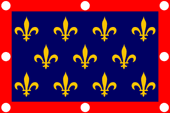
1291–1365,
Flag of Alençon,
Source, by:
Wikipedia (D)


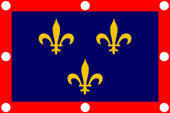
1365–1549,
Flag of Alençon,
Source, by:
Wikipedia (D)

The flag of Alençon is a scutcheon-flag, its design is actually the image of the coat of arms of that line of the Valois, which got Alençon in 1291 as a fiefdom, when King Philip IV. of France handed over the County of Alençon to his brother Charles of Valois. This image of the flag was transfered to the area in which the county was located in modern times. Flags in today's sense did not exist at that time, possibly a banner with the heraldry of the sovereign. With a few exceptions, such banners (including the coats of arms) had in France nothing to do with the country, they were only referred to the coats of arms of the respective rulers.
Source:
Wikipedia (D),
Volker Preuß
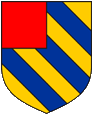
ca. 1080–1217,
Coat of arms of the Montgomery,
Source, by:
Wikipedia (D)
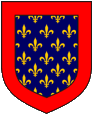
1291–1297,
Coat of arms of the County of Alençon,
Source, by:
Wikipedia (FR)
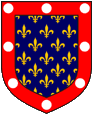
1297–1365,
Coat of arms of the County of Alençon,
Source, by:
Wikipedia (D)
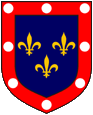
1365–1549,
Coat of arms of the Duchy of Alençon,
Source, by:
Wikipedia (D)
The progenitor of the line of Valois, Prince Charles (1270–1325, son of King Philipp III.), Count of Valois, Anjou and Maine, took over the coat of arms from Prince John Tristan (1250–1270, Count of Valois, son of King Ludwig IX.). He surrounded the lily arms of the Capetians with a wide red border. For the line of Valois-Alençon, which began in 1297, when Charles II., son of Charles of Valois, was born, were fixed eight white balls on the red border as the special heraldic feature. The coat of arms of the Capetians showed three golden lilies on blue, but originally was the coat of arms sprinkled with lilies. From 1365 (by others sources 1376), the number of lilies was reduced to three. The lily-symbol is very old, already the Germanic tribe of the Franks has used it. The House of the Capetians has provided the kings of France between 987 and 1328. It goes back to Hugo Capet, son of Hugo the Great, who was electet to the King of France, in 987, after the death of King Ludwig V. from the House of the Carolingians. The Capetians brought out three branch lines which became the Kings of France: Valois 1328–1589, Bourbon 1589–1792 and 1814–1830, and Orléans 1830–1848.
Source:
Heraldique Europeenne,
Volker Preuß,
Wikipedia (D)
The historical, French Regions:

in black: governorate and province in 1776,
in red: former county, province oder governorate
Map: Volker Preuß
The provinces (or governorates) that existed until the French Revolution were historically grown entities that had often developed from former fiefdoms of the French crown, historical counties and duchies, often existed for hundreds of years and had preserved regional characteristics (cultural peculiarities and regional languages). Such phenomena were naturally undesirable to the French Revolution, and in the context of its bloody and violent egalitarianism, all regional references were eradicated. Shortly after the Revolution, the provinces were dissolved and France was divided into many small départements, which were to be approximately the same size and have the same status, controlled by prefects of the central administration in Paris. The departments were named after rivers or mountains so as not to use the names of any of the old provinces. However, it was not possible to sever the ties between the inhabitants of France and their respective historically grown regions, so that in 1960 regions were created again. There can hardly be said to be any real autonomy. The regions are only supposed to promote the economic, social, health, cultural and scientific development of the region, keep an eye on housing and living conditions, and provide support in some areas, e.g. urban development policy, urban regeneration, regional planning, preservation of regional identity and promotion of regional languages. When the regions were formed, departments located in a particular historical province were administratively grouped together into a region that often had the same historical name. The resulting entities only roughly corresponded to the boundaries of historical provinces. In strictly centralised France, however, any form of responsible regionalism is avoided. The regions do not even have their own seals with which to mark their own legally binding decisions, because there are no plans to introduce such a thing. Therefore, anything to do with coats of arms or flags is completely irrelevant. The logos of the regions are used generally, sometimes with the colours reversed and placed arbitrarily on flags or banners. There are no rules, as they are not official symbols. The logos and flags of the regions therefore often look like company logos: Unloving, unhistorical, technocratic and modernistic. That is why most of these regions have a kind of unofficial heraldic flag, which is intended to recall historical heraldic models. However, these are merely decorative in nature and are not a symbol of sovereign functions. The regions created in 1960 were even called into question in 2014, and a territorial reform was decided – centrally from Paris – which reduced the number of regions by almost half through mergers. The regions and their institutions were not even consulted on this matter.
Wikipedia Link to the regions of France:
click or tap here
FOTW Link to the regions of France:
click or tap here
Source: Flags of the World,
Wikipedia (D),
Volker Preuß
ca 1080 · establishing of the County of Alençon around the Dominion of Bellême, whose heiress Mabile de Bellême marries Roger II. de Montgomery
1217 · death of Robert III. de Montgomery, the reign of the House of Montgomery as the Counts of Alençon ends
1220 · the heiress Countess Alix sells the county to King Philip II. of France (Capetian), Alençon gets affiliated to the French royal domain
1268 · King Louis IX. of France (Capetian) hands over the county of Alençon to his fifth son Peter
1284 · death of Peter I. of Alençon, the county gets re-affiliated to the French royal domain
1291 · King Philip IV. of France (Capetian) hands over the territorially enlarged County of Alençon to his brother Charles of Valois, the county is inherited in the afteryears within the House of Valois-Alençon
1414 · the County of Alençon is rised to a duchy
1517 · Duke Charles IV. is Duke of Berry
1521 · death of Charles IV. , Duke of Alençon and Duke of Berry, because there are no descendants, the line of Valois-Alençon extincts, the inheritance goes to his wife Margaret, Duchess of Alençon and Duchess of Angoulême
1525 · Margaret is Countess of Armagnac
1549 · death of Margaret, Duchess of Alençon, the Duchy of Alençon gets re-affiliated to the French royal domain
1559–1566 · Catherine de Medici – by marriage of King Henry II. since 1547 Queen of France – is the Duchess of Alençon
1570 · King Charles IX. of France (Valois) hands over the Duchy of Alençon to his younger brother Francis-Hercules, Duke of Anjou, he died childless in 1584, the duchy gets re-affiliated to the French royal domain, the title of Duke of Alençon is awarded in the following years as an appanage to royal princes again and again, but the Duchy becomes affiliated to the province of Normandy
1710 · King Louis XIV. of France (Bourbon) gives the title to his grandson, the Duke of Berry
1774 · King Louis XVI. of France (Bourbon) gives the title to his eldest brother, the Count of Provence
1844–1910 · Prince Ferdinand Philipp, member of the House of Orléans, has the title of the Duke of Alençon
Source:
Wikipedia (D),
Meyers Konversationslexikon
The name of the country goes of course back to the residence of Alençon. About the origin or the meaning of the name is nothing known. However, during the late Antiquity and the Merovingian period the place Alençon was called "Montsort".
Source:
Wikipedia (FR),
Volker Preuß