This page is part of the project
www.flag-encyclopedia.com


zur deutschen Version, Flagge klicken oder tippen

Algeria


Contents

Flags

Meaning/Origin of the Flag

Coat of Arms

Historical Coats of Arms

Meaning/Origin of the Coat of Arms

Aircraft Roundel

Map

Numbers and Facts

History

Origin of the Country's Name


Flags

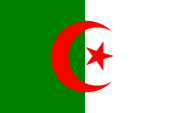
The flag of Algeria, the national and civil or Merchant flag, with two vertical stripes in green and white and a red crescent with a red five‑pointed star in the centre of the flag
National- and merchant flag,
ratio = 2:3,
Source, by: Corel Draw 4


The naval ensign of Algeria, with two vertical stripes in green and white, a red crescent and red five‑pointed star in the centre, and two crossed anchors in the upper hoist corner
Naval flag,
ratio = 2:3,
Source, by: Wikipedia (EN), commons.wikimedia.org


The naval jack of Algeria, a plain blue field with a reduced national flag in the upper hoist corner
Naval jack,
ratio = 2:3,
Source, by: Flags of the World, commons.wikimedia.org


The presidential flag of Algeria, with two vertical stripes in green and white, a red crescent and red five‑pointed star in the centre, and golden Arabic inscriptions above and below
Flag of the President,
ratio = 2:3,
Source, by: Wikipedia (EN), commons.wikimedia.org


hoch/up


Meaning/Origin of the Flag

The flag of Algeria shows two vertical stripes in green and white, above that, "above all", a red half-moon with a red five-pointed star. The color green, the half-moon and the star are symbols of islam, while red was formerly the color of socialism, but stands today for freedom. The white color stands for uprightness and honesty. It goes back to a standard of the freedom-hero Abd el-Kader (1808–1883). The flag was first in use in 1925 at anti French demonstrations. Afterward it was adopted by the Algerian People's Party, and in 1954 even by the National Liberation Front (FLN). On 3rd of July in 1962, the independence day, the flag was officially hoisted up. The creator of the flag is Messali Haj. The colours of the flag are precisely defined according to the colour values in Rood’s contrast chart: green 5,411 angstroms at 600, red 6,562 angstroms at 285. The following values are recommended for printing in spot colours: red in Pantone 186 C, green in Pantone 356 C. The naval ensign or ensign is designed in the same way as the national flag, but also features two crossed anchors in the top corner. The naval jack, the bow flag flown on warships, is a plain blue flag cloth with a smaller version of the national flag in the top corner. The presidential flag is designed in the same way as the national flag, but but also features above the crescent and star, in gold, it bears the inscription: "الجمهورية الجزائرية الديمقراطية الشعبية" – "People's Democratic Republic of Algeria", and below the crescent and star, in gold, the inscription: "بالشعب وللشعب" – "By the people and for the people".

Source: Die Welt der Flaggen, Flaggen Wappen Hymnen, Wikipedia (EN)

hoch/up


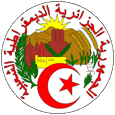
Coat of Arms


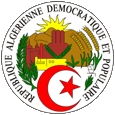
Coat of arms of Algeria, consisting of a disc with a red crescent and star in the centre, above which is a landscape featuring ears of corn, the Hand of Fatima and a rising sun; the name of the country is written in Arabic around the Edge
since 1976,
Coat of arms of Algeria,
Source, by: Wikipedia (D)

hoch/up


Historical Coats of Arms


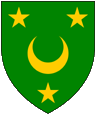
Coat of arms of Algeria, a green shield bearing a golden crescent and three golden five-pointed stars
1830–1962,
Coat of arms of Algeria,
Source, by: Wikipedia (EN)


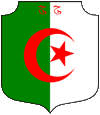
Coat of arms of Algeria, a shield divided between green and white, with a red crescent and star in the centre
1962–1971,
Coat of arms of Algeria,
Source, by: images.civicheraldry.com, 2010, Civic Heraldry, Wikipedia (D)


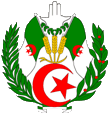
Coat of arms of Algeria, featuring a red crescent and star in the centre, surmounted by ears of corn, two crossed Algerian flags and the Hand of Fatima, all set within a wreath of branches
1971–1975,
Coat of arms of Algeria,
Source, by: Flags of the World, Corel Draw 4, Wikipedia (D)


Coat of arms of Algeria, consisting of a disc with a red crescent and star in the centre, above which is a landscape featuring ears of corn, the Hand of Fatima and a rising sun; the name of the country in French appears around the edge
1975–1976,
Coat of arms of Algeria,
Source, by: Flags of the World, Flaggen Wappen Hymnen

hoch/up


Meaning/Origin of the Coat of Arms

Initially, the coat of arms of Algeria was shown on a shield, but from 1971 - following French heraldic tradition - no coat of arms was used in Algeria, but a state seal. At first it was black and white, later also colored. It was round and showed a red star and a red crescent in the middle, three ears of wheat, two state flagnes and the hand of Fatima, a symbol of luck, above the crescent. The whole thing was surrounded by a wreath of a palm and an olive branch. In 1975 a new seal was introduced. In addition to the hand of Fatima and the crescent moon with the star, it also shows a mountain landscape with the rising sun, industrial plants and agricultural crops, since 1976 with an Arabic inscription.

Source: Flags of the World, Die Welt der Flaggen, Flaggen Wappen Hymnen

hoch/up


Aircraft Roundel


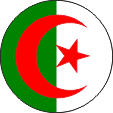
Aircraft roundel of Algeria
Aircraft Roundel,
Source, by: Wikipedia (EN)


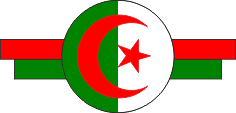
Aircraft roundel of Algeria
1962–1964,
Aircraft Roundel,
Source, by: Wikipedia (EN)

hoch/up


Map

Location:

Source: CIA World Factbook

Map of the country:

Source: CIA World Factbook

hoch/up


Numbers and Facts

Area: 919.591 square miles

Inhabitants: 45.765.554 (2023), thereof 20.000 Europeans

Religions: 99% Muslim, 0,7% Christian

Density of Population: 50 inh./sq.mi.

Capital: Algier (Al-Djazâir), 2.159.000 inh. (2008)

official Language: Arabian, Tamazight

other Languages: French

Currency: 1 Algerian Dinar (DA, DZD) = 100 Centimes

Time Zone: GMT + 1 h

Source: Wikipedia (D)

hoch/up


History

Early Times · settlement by Berber tribes, in the east by Tuareg tribes

12th century B.C. · Phoenician trading bases on the coast

202 B.C. · Kingdom of Numidia

46 B.C. · conquest of Numidia by the Roman Empire, united with Carthage to form the Roman province of Numidia-Mauretania

429 A.D. · invasion of the Vandals, foundation of the Vandal Empire

534 · conquest by the East Roman Empire (Byzantium)

697 · conquest by the Arabs, Islamization

11th century · the Berber dynasty of the Almoravids takes over

1147 · the Almohad dynasty takes power

13th century · the Almohad empire falls apart

1269 · Kingdom of the Abd-al-Wadids in the west

16th century · Spain tries to take over the coast

1519 · the region searches the protection of the Ottoman Empire, but is subjugated by the Turks and becomes a Vilâyet

1711 · the region is able to break away from the suzerainty of the Ottoman Empire, maximum development of piracy and the capture of slaves

1830 · France begins to conquer the region

1847 · decisive victory of the French against Abd el-Kader

1881 · France gains full control over the north of the country, three departments are annexed directly to France

1947 · Algeria statute, all residents of the country receive French citizenship

1954 Beginning of the Algerian war for the country's independence (until 1962), under the leadership of the National Liberation Front (FLN)

05.07.1962 · Algeria gains independence, development of a dictatorship of the FLN

1965 · military coup by Colonel Houari Boumedienne, turning to socialism

1988 · riots, the FLN gives up its monopoly on power, new constitution

1991/1992 · parliamentary elections, because of a feared victory by Islamists, the power is gradually taken over by the military

1992–2002 · civil war

the 2020s · a new constitution and political reorganisation

Source: Wikipedia (D)

hoch/up


Origin of the Country's Name

The name of the country goes back to the capital Algiers. The name of the capital is in Arabic: "Al-Djazair" what means "The Island", and refers to the situation of the around the years 950 by Berbers founded city.

Source: Handbuch der geographischen Namen

hoch/up


Click here to go to the start page