zur deutschen Version, Flagge klicken oder tippen

- Republik Argentinien
- Eigenbezeichnung: República Argentina
• today's Flags
• historical Flags
• Meaning/Origin of the Flag
• Coat of Arms
• Meaning/Origin of the Coat of Arms
• Aircraft Roundel
• Maps
• Numbers and Facts
• History
• Origin of the Country's Name
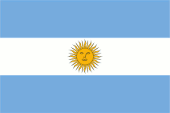
since 1985
National, merchant, state and naval flag,
ratio = 2:3,
Quelle, nach:
Corel Draw 4, Flaggen und Wappen, Das farbige Flaggenlexikon, Wikipedia (EN)



since 1985,
alternative National and merchant flag,
ratio = 2:3,
Quelle, nach:
Corel Draw 4, Flaggen und Wappen, Das farbige Flaggenlexikon, Wikipedia (EN)

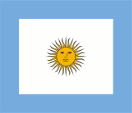
Jack,
ratio = 6:7,
Quelle, nach:
Corel Draw 4, Flaggen und Wappen, Das farbige Flaggenlexikon, Wikipedia (EN)
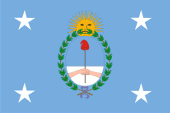
Flag of the President,
ratio = 3:4,
Source:
Corel Draw 4, Flaggen und Wappen, Flags of the World

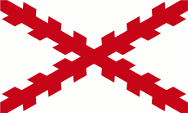
to 1785,
Flag of the Viceroyalty of Peru and naval and war flag
Source, by:
Wikipedia (EN)

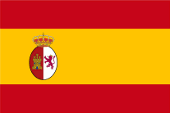
1785–1810,
Flag of Spain and flag of the Viceroyalty of Peru,
Source, by:
World Statesmen
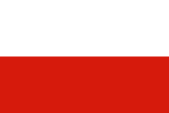
1810–1812,
National flag,
ratio = 2:3,
Source, by:
World Statesmen
to 1985,
National and merchant flag,
ratio = 2:3,
Quelle, nach:
Corel Draw 4, Flaggen und Wappen, Das farbige Flaggenlexikon, Wikipedia (EN)
to 1985,
State and naval flag,
ratio = 2:3,
Quelle, nach:
Corel Draw 4, Flaggen und Wappen, Das farbige Flaggenlexikon, Wikipedia (EN)
The flag was officially introduced on the 27th of February, 1812. It was designed by General Manuel Belgrano and shows three horizontal stripes in pale blue, white and pale blue, and the state flag shows the "May Sun" in the middle of the white stripe since the 25th of Feb. 1818. The "May Sun" is a national symbol, which remembers the 25th of May in 1810, a day with a great demonstration on the market of the capital, when there were handed over some claims to the Viceroy. Initially, the sky was overcast, after announcing the claims the clouds opened and the sun began to shine. According to other sources General Belgrano had been inspired during the Battle of Paraná to that picture, as he looked to the sky and into the sun. In reality, the sun symbol is much older. It is the Inka sun, it stands for Inti, the son of the creator Viracocha. About the origin of the Flag and about the meaning of the colours there in principle exist two theories, the first is valid as official but the second is probably.
1) The colours go back to the blue-white cockades, which where allocated at the onset of the struggle for freedom on the 25th of May, 1810. The ”May Sun” is also a reminder of this day, which was adopted into the state and naval flag, the jack und into the coat of arms of the state. Blue stands for the sky, white for the snow covered peaks of the Andes. The design of the flag pictures the position of the South American mainland between both large oceans.
2) The flag of Argentina is the very detailed image of an apron like the Freemasons of the "blue" lodges use it in the first three ranks (apprentice, journeyman, master) during their ritual works: white with an azure border and on-stitched one to three suns, per according to the rank. General Belgrano was a Freemason – like in this years all freedom heros in North and South America (e.g. the Generals Jose San Martin, George Washington, Simon Bolivar and Friedrich Wilhelm von Steuben). The most important centres of the anti-feudal acting of the Freemasons were at that time the Paris Lodge "Les Neuf Soeurs" and the Lodge "Lautaro" in Buenos Aires. The suspicion is obvious that Belgrano want from begin on nothing other then to introduce the image of an apron as flag of the free La Plata (since 1826 named Argentina).
Originally, the version of the flag with the sun in the middle was used only as a war flag (naval flag). From 1884 it was also to be used on public buildings and thus it became also the state flag. The version of the flag without the sun in the middle was the national and merchant flag. Since 1985, citizens have also been allowed to use the flag with the sun. The division between the state and naval flags on the one hand and the national and merchant flags on the other is therefore obsolete.
The shades of the colours of the flag are defined, most recently with the IRAM standard / Decree 1650/10 of November 2010, which specifies values, including as LAB or Pantone colours: Yellow/gold = Pantone 1235 c, light blue = Pantone 284 c and also brown = Pantone 1685 c.
Source, by:
1) Die Welt der Flaggen,
Flaggen Wappen Hymnen,
Flaggen und Wappen der Welt,
Alle Flaggen alle Staaten
2) Hans-Peter Meinzer, Translator of the English text: Joachim Nuthack
3) Wikipedia (D)
4) Wikipedia (EN)
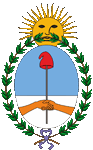
Coat of arms of Argentina,
Source:
Corel Draw 4
The coat of arms of Argentina was adopted in 1813, and it was confirmed in today's form by the decree of the 24th of April, 1944. Its roots lie in the seal, which was in use by the parliament of the United Provinces of Rio de la Plata on the 13th of March, 1813. It shows on blue above silver (white) a brown stick with a red freedom cap (Jacobin cap, Phrygian cap), held by two in a handshake united arms in the foot of the shield, surrounded by a laurel wreath with a blue ribbon atthe bottom, and the golden ”May Sun” at the top. Both, sun and cap, symbolize freedom.
Source, by: Die Welt der Flaggen,
Flaggen Wappen Hymnen,
Flaggen und Wappen der Welt, Translator of the English text: Joachim Nuthack

Aircraft roundel,
Source, by: Wikipedia (EN)
Location:
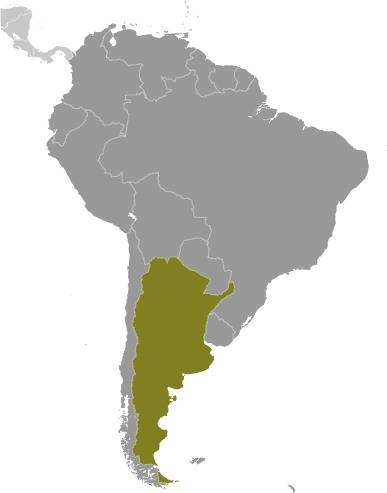
Source: CIA World Factbook
Map of the country:
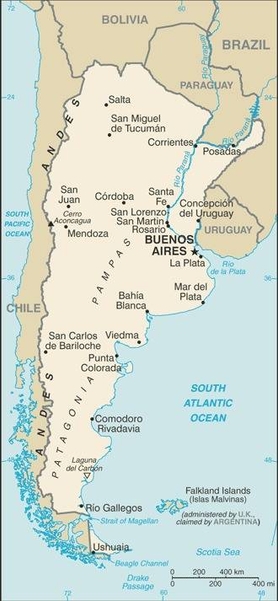
Source: CIA World Factbook
Area: 1.072.158 square miles
Inhabitants: 46.234.830 (2022), thereof 90% of European descent (including ca. 1.250.000 Germans and German descendants), 3% native Indians and Mestizos, 2% Arabs
Density of Population: 43 inh./sq.mi.
Religions: 80% Roman Catholic, 5% Protestant, 2% Muslim, 1% Jewish
Capital: Buenos Aires, 3.120.612 inh. (2022)
official Language: Spanish
other Languages: Italian, German, Welsh, Quechua, Guarani, Basque and Arabic
Currency: 1 Argentine Peso = 100 Centavos
Time Zone: GMT – 3 h
Source:
Wikipedia (D)
ca. 15.000 v. Chr. · probable first settlement
13./14. Jhd. · expansion of the Inca Empire into north‑western Argentina
1516 · discovery of the Río de la Plata
1536 · founding of Buenos Aires, beginning of Spanish colonisation, part of the Viceroyalty of Peru
1776 · establishment of the Viceroyalty of the Río de la Plata with Buenos Aires as its capital
25.05.1810 · May Revolution in Buenos Aires, overthrow of the viceroy
1811 · secession of Paraguay
09.07.1816 · declaration of independence in Tucumán
1825 · secession of Bolivia
24.12.1826 · founding of the Republic of Argentina
1828 · secession of Uruguay
1852–1861 · civil war
1853 · constitution
1862 · national unification under President Mitre
1864–1870 · War of the Triple Alliance against Paraguay
1880–1930 · massive immigration from Italy and Spain, economic boom
1912 · introduction of universal male suffrage
1916–1930 · administration of the Unión Cívica Radical
1940ies–1955 · era of Peronism under Juan Domingo Perón (social reforms, strengthening of the working class, industrialisation, authoritarian tendencies, conflicts with the Church)
1955 · military coup, Perón goes into exile
1955–1983 · instability, alternating civilian governments and military coups
1976–1983 · military dictatorship (“Dirty War” with approx. 30,000 disappeared persons [Desaparecidos]), rise of human rights movements (Madres de Plaza de Mayo)
1982 · defeat in the Falklands War against the United Kingdom
1983 · return to democracy under Raúl Alfonsín
1990ies · neoliberal reforms under Carlos Menem, currency peg to the US dollar
1998–2002 · severe economic crisis, followed by alternating governments, economic recovery and renewed crises
2023 · beginning of the presidency of Javier Milei, sweeping and successful economic reforms
Source, by: Wikipedia (D),
Atlas zur Geschichte
This country was first called "La Plata" and was a Spanish viceroyalty. The name was transferred from the river "Rio de la Plata – The Silver River" to the country. Later, the river was, however, renamed in "Rio Paraná", and the country was called now "Argentina". That means "The silver country," because it derives from the Latin word "Argentum", what means "silver". This name became officially not until 1826 .
Source, by: Handbuch der geographischen Namen
Kindly supported by: Hans-Peter Meinzer