This page is part of the project
www.flag-encyclopedia.com


zur deutschen Version, Flagge klicken oder tippen

Albania


Contents

Flags

Historical Flags

Meaning/Origin of the Flag

Coat of Arms

Historical Coats of Arms

Meaning/Origin of the Coat of Arms

Aircraft Roundel

Map

Numbers and Facts

History

Origin of the Country's Name


Flags

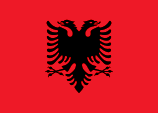
Flag of Albania, as national flag, with a red field and a black double‑headed eagle in the centre
since 1992,
National flag,
ratio = 5:7,
Source, by: Wikipedia (D)


Merchant flag of Albania with three horizontal stripes in red, black and red
Merchant flag,
ratio = 2:3,
Source, by: Flags of all Nations


Naval flag of Albania as a plain white field with a narrow horizontal red stripe at the bottom and a black double‑headed eagle in the centre
Naval flag,
ratio = 2:3,
Source, by: Flags of all Nations


Auxiliary or official flag at sea of Albania used by state maritime authorities, a plain white field with a narrow horizontal blue stripe at the bottom and a black double‑headed eagle in the centre
Flag of aux ships (State flag at sea),
ratio = 2:3,
Source, by: Wikipedia (D)


Flag of the President of Albania, a plain square red field with a black double‑headed eagle in the centre
Flag of the president,
ratio = 1:1,
Source, by: Wikipedia (D)


hoch/up


Historical Flags

National flag of Albania from 1912–1913, a plain red field with a black double‑headed eagle in the centre and a white six‑pointed star above it
1912–1913,
Republic of Albania,
National flag,
Source, by: Flags of the World


Flag of the Principality of Albania in 1914 as the national flag, a plain red field with a black double‑headed eagle in the centre and a white five‑pointed star above it
1914,
Principality of Albania,
National flag,
Source, by: Flags of the World


Merchant flag of the Principality of Albania from 1914, a plain red field with three horizontal stripes in red, black and red and a white five‑pointed star centred on the black stripe
1914,
Principality of Albania,
Merchant flag,
Source, by: Flags of the World


Standard of Wilhelm, Prince of Wied and Prince of Albania in 1914, a plain square red field with a black double‑headed eagle in the centre and a crown above it
1914,
Principality of Albania,
Standard of William Prince of Wied, Prince of Albania,
Source, by: Flags of the World


National flag of Albania from 1914–1920, a plain red field with a black double‑headed eagle in the centre
1914–1920,
Republic of Albania,
National flag,
ratio = 2:3,
Source, by: Flags of the World


National, naval and war flag of Albania from 1920–1928, a plain red field with a black double‑headed eagle in the centre
1920–1928,
Republic of Albania,
National-, naval und war flag,
ratio = 2:3,
Source, by: Flags of the World


Merchant flag of Albania from 1920–1928 with three horizontal stripes in red, black and red
1920–1928,
Republic of Albania,
Merchant flag,
ratio = 2:3,
Source, by: Flags of the World


Presidential flag of Albania from 1920–1928, a plain red field with a black double‑headed eagle in the centre and the Crown of Skanderbeg above it
1920–1928,
Republic of Albania,
Flag of the president,
ratio = 2:3,
Source, by: Flags of the World


National flag of the Kingdom of Albania from 1928–1939, a plain red field with a black double‑headed eagle in the centre
1928–1939,
Kingdom of Albania,
National flag,
ratio = 2:3,
Source, by: Flags of the World


State flag of the Kingdom of Albania from 1928–1939, a plain red field with a black double‑headed eagle in the centre and the Crown of Skanderbeg above it
1928–1939,
Kingdom of Albania,
State flag,
ratio = 2:3,
Source, by: Flags of the World


Merchant flag of the Kingdom of Albania from 1928–1939 with three horizontal stripes in red, black and red
1928–1939,
Kingdom of Albania,
Merchant flag,
ratio = 2:3,
Source, by: Flags of the World


Flag of the King of Albania from 1928–1939, a plain red field with a black double‑headed eagle in the centre, the Crown of Skanderbeg above it and a wreath of wheat below it
1928–1939,
Kingdom of Albania,
Flag of the king,
ratio = 1:1,
Source, by: Flags of the World


National flag of the Kingdom of Albania from 1939–1943, a plain red field with a black double‑headed eagle on a shield in the centre, flanked on both sides by a fasces
1939–1943,
Kingdom of Albania,
National flag,
ratio = 2:3,
Source, by: Flags of the World, F l a n k e r, Public domain, via Wikimedia Commons


State flag of the Kingdom of Albania from 1939–1943, a plain red field with a black double‑headed eagle on a shield in the centre, flanked on both sides by a fasces and topped with a golden crown
1939–1943,
Kingdom of Albania,
State flag,
ratio = 2:3,
Source, by: Flags of the World, F l a n k e r, Public domain, via Wikimedia Commons


National flag of Albania from 1943–1944, an elongated red field with a black double‑headed eagle in the centre
1943–1944,
National flag,
ratio = 1:2,
Source, by: Flags of the World


State flag of Albania from 1943–1944, an elongated red field with a black double‑headed eagle in the centre and the Crown of Skanderbeg above it
1943–1944,
State flag,
ratio = 1:2,
Source, by: Flags of the World


National flag of the Socialist People’s Republic of Albania from 1946–1992, a plain red field with a black double‑headed eagle in the centre and a red star with a golden outline above it
1946–1992,
Socialist People's Republic of Albania,
National flag,
ratio = 5:7,
Source, by: Flags of the World


Naval ensign of the Socialist People’s Republic of Albania from 1946–1954, with three horizontal stripes in red, black and red and a golden anchor with a red star in the centre of the black stripe
1946–1954,
Socialist People's Republic of Albania,
Naval flag,
ratio = 2:3,
Source, by: Flags of the World


Naval ensign of the Socialist People’s Republic of Albania from 1954–1958, light blue with the plain red national flag bearing a black double‑headed eagle in the canton
1954-1958,
Socialist People's Republic of Albania,
Naval flag,
ratio = 2:3,
Source, by: Flags of the World


Naval ensign of the Socialist People’s Republic of Albania from 1958–1992, a plain white field with a narrow horizontal red stripe along the bottom edge and a black double‑headed eagle with a red star outlined in gold above it in the centre
1958–1992,
Socialist People's Republic of Albania,
Naval flag,
ratio = 2:3,
Source, by: Flags of the World


Auxiliary or official flag at sea of the Socialist People’s Republic of Albania from 1958–1992, used by state maritime agencies and authorities, a plain white field with a narrow horizontal blue stripe along the bottom edge and a black double‑headed eagle with a red star outlined in gold above it in the centre
1958–1992,
Socialist People's Republic of Albania,
Flag of aux ships (State flag at sea),
ratio = 2:3,
Source, by: Flags of the World


Merchant flag of the Socialist People’s Republic of Albania from 1946–1992, with three horizontal stripes in red, black and red and a red five‑pointed star outlined in gold in the centre of the black stripe
1946–1992,
Socialist People's Republic of Albania,
Merchant flag,
ratio = 2:3,
Source, by: Flags of the World


Naval jack of the Socialist People’s Republic of Albania from 1958–1992, a plain red field with a large red five‑pointed star outlined in white in the centre
1958–1992,
Socialist People's Republic of Albania,
Naval jack,
ratio = 2:3,
Source, by: Flags of the World


Presidential flag of the Socialist People’s Republic of Albania from 1946–1992, a square plain red field with a black double‑headed eagle in the centre and a red star with a golden outline above it
1946–1992,
Socialist People's Republic of Albania,
Flag of the President,
ratio = 1:1,
Source, by: Flags of the World


hoch/up


Meaning/Origin of the Flag

The flag of Albania goes directly back to the national hero Skanderbeg. He was of origin, and was named really George Kastriota. He led an anti-Turkish revolt between the years 1443 and 1468, after the ever further expanding Ottoman Empire since 1385 had wrestled down Epirus, the remaining rump territory of Byzantium, the Empire began to subdue the territory of today's Albania. During the revolt Skanderbeg used red flags with a black double-headed eagle. He was probably Skanderbeg inspired by the Byzantine flag. Ostensibly, the legend that the Albanians are descendants of eagles, might also have played a role.

After the declaration of independence from the Ottoman Empire on the 28th of November, 1912, they remember the old flag, and introduced a red flag, with a black two-headed eagle and a six-pointed star above. The star was to be a reminder for Albanians, that they have the same firmament above their heads regardless to which religion they may belong. When the German Prince Wilhelm zu Wied became Prince of Albania, the flag was changed a little, because a part of the old Epirus now belonged to Albania, the four golden lightning bolts in the claws of the eagle representing Epirus were incorporated. When on the 1st of September, 1928 Ahmed Zogu became Albanian King, he caused a changing of the flag: the golden helmet of Skanderbeg was placed on the state flag. When Italy occupied in 1939 Albania, the flag of Albania was changed again: The Albanian crown was added to the eagle and two bundles of black Fasces (the Roman symbol for the authority of the Lictors).

Likewise, the anti-Italian resistance, under communist leadership, used the red flag with the eagle, with a yellow five-pointed star above its heads. This flag was officially introduced on the 15th of March, 1946 in connexion with the founding of the people's republic. With the resignation of the last communist president the star was deleted from the flag on the 7th of April, 1992.

Source: Die Welt der Flaggen, Flaggen und Wappen der Welt Translator of the English text: Joachim Nuthack

hoch/up


Coat of Arms


The coat of arms of Albania featuring a black double-headed eagle
since 1993,
Coat of arms of Albania,
Source, by: Wikipedia (D), Government of Albania, Public domain, via Wikimedia Commons

hoch/up


Historical Coats of Arms


The coat of arms of Albania featuring a black double-headed eagle
1946–1992,
Coat of arms of Albania,
Source, by: Flaggen und Wappen der Welt


The coat of arms of Albania featuring a black double-headed eagle
1992–1993,
Coat of arms of Albania,
Source, by: Flaggen und Wappen der Welt

hoch/up


Meaning/Origin of the Coat of Arms

In connexion with the founding of the people's republic (1946) different coat of arms was also introduced. The eagle was surrounded by ears of grain, and above the eagle was placed, as on the flag, a red yellow-bordered five-pointed star. The ears of grain were bound with a red ribbon, which contained the date 24th of May, 1944. On this date a so-called "anti-faschist liberation committee" was formed in Permeti. On the 7th of April, 1992 the ribbon with the date and the star was initially removed, however, since the 22nd of May, 1993 the black twin-headed eagle in a red shield was in use. Since 2004 appears above the eagle the golden helmet of Skanderbeg.

Source: Flaggen und Wappen der Welt, Translator of the English text: Joachim Nuthack

hoch/up


Aircraft Roundel


The aircraft roundel of Albania
1962–1992,
Aircraft Roundel,
Source, by: Wikipedia (EN)


The aircraft roundel of Albania
since 1992,
Aircraft Roundel,
Source, by: Wikipedia (EN)

hoch/up


Map

Location:

Source: CIA World Factbook

Map of the country:

Source: CIA World Factbook

hoch/up


Numbers and Facts

Area: 11.099 square miles

Inhabitants: 2.402.113 (2023), thereof 83% Albanians, 2% Greeks

Religions: 56% Muslim, 10% Catholic Christian, 7% Albanian Orthodox Christian

Density of Population: 216 inh./sq.mi.

Capital: Tirana, 418.500 inh. (2011)

official Language: Albanian

other Languages: Macedonian, Greek, Italian

Currency: Lek (ALL)

Time Zone: GMT + 1 h

Source: Wikipedia (D)

hoch/up


History

380 B.C. to 168 B.C. · Empire of the Illyrian Labeates

395 A.D. · when the Roman Empire is divided, today's Albania comes to the Eastern Roman Empire (Byzantium)

591 · Slav invasion

880–1018 · central and southern Albania are part of the Bulgarian Empire

1081 · Norman Invasion

1204–1430 · from the end of the 4th Crusade (collapse of the Byzantine Empire), parts of the country come to Naples, Serbia and Venice and local Albanian principalities emerge (Kruja, Thopias, Balscha)

1430 · Attacks by the Turks

1443–1468 · Prince Georg Kastriota Skanderbeg's successful defensive battle against the Turks

1479 · the country becomes part of the Ottoman Empire

1910 · Anti-Turkish uprising, only the big cities are under control of the Ottoman Empire

28th of November 1912 · independence as the Republic of Albania

21st of February in 1914 · the leaders of the often divided Albanian ethnic and religious groups offer Wilhelm Prinz zu Wied in Neuwied (Rhineland) the Albanian crown, he becomes Prince Wilhelm I. of Albania, the great powers promise support

March to August 1914 · Wilhelm I. comes under pressure from revolts by the Greeks, Muslims and local rulers, the great powers do not provide any support

3rd of September 1914 · Wilhelm I. emigrates to Romania, but never abdicates, the country is occupied by foreign powers during the First World War, the nominal republic of Albania continues to exist, Italy, Serbia and Greece occupy and claim parts of the country for themselves until 1920

1917 · Wilhelm I. demands his reinstatement

1919 · negotiations on the division of the land

January 1920 · Albanian Congress of Lushnja, deposition of the government of Turhan Pascha, new election of a government under Sulejman Delvina, which is quickly recognized internationally, the occupying powers withdraw

December 1920 · joining to the League of Nations

1925 · authoritarian reign of Ahmet Zogu

1928 · Ahmet Zogu proclaims himself king, the now Kingdom of Albania becomes increasingly dependent from Italy in the following years

1939 · Second World War, Italy occupies the country, Victor Emanuel, King of Italy, is installed as King of Albania in personal union, Ahmet Zogu flees, in the following years establishes and increases a by communists dominated resistance

8th of September in 1943 · Italy surrenders, German troops occupy the country

24th of May in 1944 · Congress of Përmet, formation of a provisional communist government

29th of November in 1944 · the German troops leave the country

11th of January in 1946 · proclamation of the People's Republic of Albania

14th of May in 1955 · joining to the Warsaw Pact (left in 1968)

14th of December in 1955 · joining to the United Nations (UN)

28th of December in 1976 · new constitution, rename in Socialist People's Republic of Albania

Fall 1990 · anti-communist movement

31st of March in 1991 · elections, the communist government is confirmed

4th of June in 1991 · general strike, resignation of the communist government, formation of a government of national unity, rename in Republic of Albania

9th of July in 2009 · joining to the NATO

Source: Atlas zur Geschichte, Wikipedia (D), Länder der Erde

hoch/up


Origin of the Country's Name

The name Albania has its roots in the Indogerman word "alb" → "high, or mountain", which later had been merged with the meaning of the Latin word "albus" → "white". Albania is the "Highlands". The Albanians (native name: Shiptar) call their country "Shiperija" or "Shiptarije.

Source: Handbuch der geographischen Namen

hoch/up


Click here to go to the start page