This page is part of the project
www.flag-encyclopedia.com


zur deutschen Version, Flagge klicken oder tippen

Afghanistan


Contents

Flag

Historical Flags

Meaning/Origin of the Flag

Local Flags

Coat of Arms

Meaning/Origin of the Coat of Arms

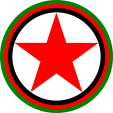
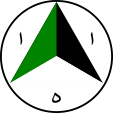
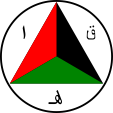
Aircraft Roundel

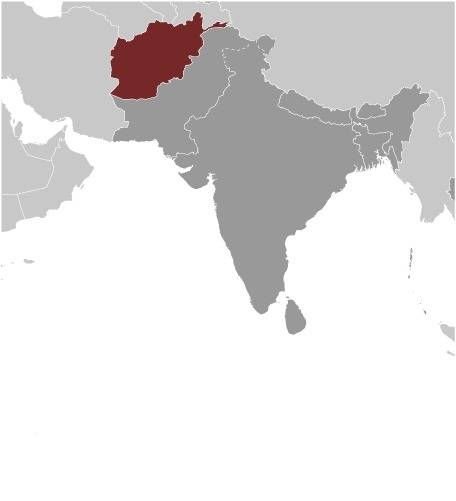
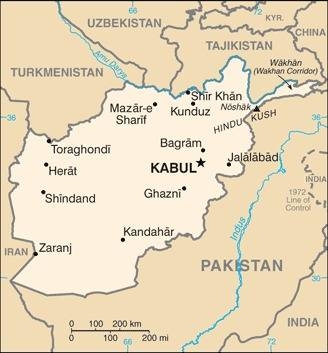
Map

Numbers and Facts

History

Origin of the Country's Name


Flag

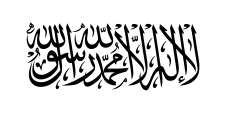
The flag of Afghanistan, shown here as the national flag under the Taliban, a white field bearing the Shahada, the Islamic declaration of faith, in black Arabic script in the centre
since 15.Aug.2021,
National flag,
ratio = 1:2,
Source: Own work based on: the flag raised at a 17 August 2021 Taliban press conference,
Public domain, via Wikimedia Commons


hoch/up


Historical Flags

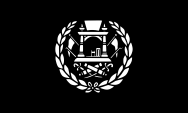
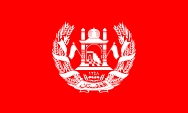
The flag of Afghanistan, shown here as the national flag under Habib Ullah in 1929, consisting of a plain black field
1880–1901,
Emirate of Afghanistan,
National flag,
ratio = 3:5,
Source, by: Wikipedia (D)


The flag of Afghanistan, shown here as the national flag from 1901 to 1919 under Amir Habibullah Khan, a plain black field bearing the white national emblem in the centre, depicting a stylised mosque
1901–1919,
Emirate of Afghanistan,
National flag,
ratio = 3:5,
Source, by: www.afghan-network.net, 2010, Flags, Wikipedia (D), QWerk. [CC BY-SA 3.0], via Wikimedia Commons


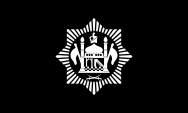
The flag of Afghanistan, shown here as the national flag from 1919 to 1921 under Aman Ullah, a plain black field bearing the white national emblem in the centre, depicting a stylised mosque on an eight‑pointed star
1919–1921,
Emirate of Afghanistan,
National flag,
ratio = 3:5,
Source, by: www.afghan-network.net, 2010, Flags, Wikipedia (D), Flanker. [Public domain], via Wikimedia Commons


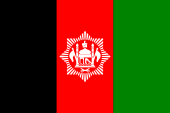
The flag of Afghanistan under Nadir Shah from 1929 to 1931, the national flag, with three vertical stripes in black, red and green and the white state emblem on an eight‑pointed star in the centre of the red field
1929–1931,
Kingdom of Afghanistan,
National flag,
ratio = 2:3,
Source, by: www.afghan-network.net, 2010, Flags, Wikipedia (D)


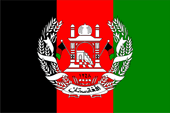
The flag of Afghanistan under Sahir Shah from 1931 to 1974, the national flag, with three vertical stripes in black, red and green and the white national coat of arms within a wreath of wheat ears in the centre of the flag
1931–1974,
Kingdom of Afghanistan,
National flag,
ratio = 2:3,
Source, by: www.afghan-network.net, 2010, Flags, Derivative work by Orange Tuesday at en.wikipedia based on OpenClipart file is by Andrew Dunhan [Public domain], via Wikimedia Commons


The obverse side of the flag of the Shah of Afghanistan, Zahir Shah, consisting of a solid red bunting with the white national coat of arms within a wreath of wheat ears in the centre of the flag
1928–1973,
Flag of the Shah (obverse side),
ratio = 3:5,
Source, by: Das Flaggenbuch


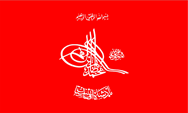
The reverse side of the flag of the Shah of Afghanistan, Zahir Shah, as a plain red flag featuring the Shahada, the Islamic creed, in white Arabic script in the centre
1928–1973,
Flag of the Shah (reverse side),
ratio = 3:5,
Source, by: Das Flaggenbuch


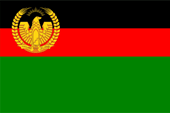
The flag of Afghanistan, the national flag, 1974–1978, consisting of three horizontal stripes in black, red and green and the country’s coat of arms in the top corner under Daud Khan
1974–1978,
Republic of Afghanistan,
National flag,
ratio = 2:3,
Source, by: www.afghan-network.net, 2010, Flags, Wikipedia (D), Orange Tuesday (talk) at en.wikipedia. [Public domain], from Wikimedia Commons


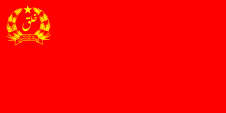
The flag of Afghanistan, the national flag under Nur Muhammad Taraki, 1978–1980, consisting of a solid red panel with the country’s coat of arms, mainly composed of Arabic letters within a wreath of wheat ears, in gold in the upper corner
1978–1980,
Democratic Republic of Afghanistan,
National flag,
ratio = 1:2,
Source, by: www.afghan-network.net, 2010, Flags, Wikipedia (D), Orange Tuesday [Public domain], via Wikimedia Commons


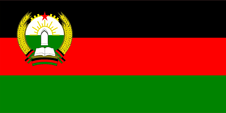
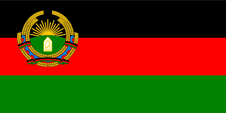
The flag of Afghanistan 1980–1987, under Amin Karmal, with three horizontal stripes in black, red and green and the state emblem with a red star in the upper corner
1980–1987,
Democratic Republic of Afghanistan,
National flag,
ratio = 1:2,
Source, by: www.afghan-network.net, 2010, Flags, Corel Draw 4, Wikipedia (D)


The flag of Afghanistan 1987–1992 under Mohammad Najibullah with three horizontal stripes in black, red and green and the state emblem in the upper corner
1987–1992,
Democratic Republic of Afghanistan,
National flag,
ratio = 1:2,
Source, by: www.afghan-network.net, 2010, Flags, Wikipedia (D), Orange Tuesday. [Public domain], from Wikimedia Commons


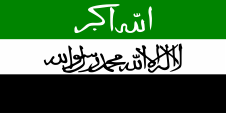
The flag of Afghanistan in 1992 under Burhanuddin Rabbani with three horizontal stripes in green, white and black, featuring the Arabic phrase Allāhu Akbar on the green stripe and the Shahada in black script on the central white stripe
1992,
National flag,
ratio = 1:2,
Source, by: www.afghan-network.net, 2010, Flags


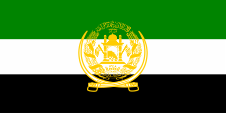
The flag of the Northern Alliance and the national flag of Afghanistan 1992–2002 under Hamid Karzai with three horizontal stripes in green, white and black and the golden state emblem with two crossed sabres in the centre
1992–2002,
Islamic State of Afghanistan, National flag,
Flag of the Northern Alliance,
ratio = 1:2,
Source, by: Flags of all Nations, User:Saul ip [GFDL or CC BY-SA 4.0], via Wikimedia Commons


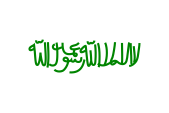
The flag of Afghanistan under the Taliban 1996–2001, a white cloth bearing the Shahada, the Islamic declaration of faith, in green Arabic script in the centre
1996–2001,
Islamic Emirate of Afghanistan, National flag,
Flag of Taliban Militia,
ratio = 2:3,
Source, by: Frank Grübe


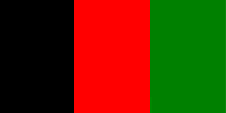
The flag of Afghanistan in 2002, the national flag under Hamid Karzai, with three vertical stripes in black, red and green
28.Jan.2002 – 05.Feb.2002,
Republic of Afghanistan,
National flag,
ratio = 1:2,
Source, by: www.youtube.com


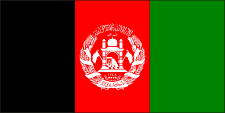
The flag of Afghanistan 2002–2004 under Hamid Karzai with three vertical stripes in black, red and green and the state emblem in the centre of the red stripe
05.Feb.2002 – 04.Jan.2004,
Republic of Afghanistan,
National flag,
ratio = 1:2,
Source, by: National flagn der Welt, Antemister, arms created by Dbenbenn [CC BY 3.0], via Wikimedia Commons


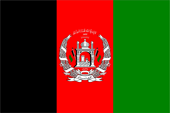
The flag of Afghanistan 2004–2013 under Hamid Karzai with three vertical stripes in black, red and green and the state emblem in the centre of the red stripe
04.Jan.2004–19.Aug.2013,
Republic of Afghanistan,
National flag,
ratio = 2:3,
Source, by: Wikipedia (D), Bahij Virtual Academy [CC BY-SA 4.0], from Wikimedia Commons


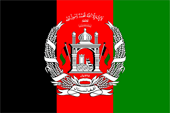
The flag of Afghanistan 2013–2021, consisting of three vertical stripes in black, red and green, with the country’s coat of arms in the centre above the red stripe over all fields
19.Aug.2013–15.Aug.2021,
National flag,
ratio = 2:3,
Source, by: Wikipedia (D), Bahij Virtual Academy [CC BY-SA 4.0], from Wikimedia Commons


hoch/up


Meaning/Origin of the Flag

The today's flag of Afghanistan was introduced on 15th of August in 2021 after the Taliban militia regained power in Afghanistan. It is solid white and shows the Shahada, the Islamic creed, in black Arabic script. It leans consciously on the flag of Saudi Arabia, because the ideology of the Taliban goes back to Wahabi Islam in Saudi Arabia. The to 15th of August in 2021 used flag of Afghanistan was introduced on 19th of August in 2013 and showed three vertical stripes, black, red and green, with the coat of arms of the state in the centre. The flag correlated nearly with the model which was valid until 1974 in the Kingdom of Afghanistan. At the top of the coat of arms only the chessada (Islamic creed) was added.

Meaning of the former colors: black stands for the dark past, red symbolizes the in the fights for freedom given blood, and green stands for the Islam. Just as is possible a pure islamic interpretation of the colors: Red is the colour of Omar, the second calif; green stands for the Fatimides, an Ismailitic-shiite calif-dynasty, which goes back to the fourth Calif Ali; and black stands for the Abbasides, a calif-dynasty, which goes back to the Calif Abbas I. Already during the times of the kingdom, 1929-1974, the black-red-green stripes of the flag had been arranged vertically. With the assumption of power by Mohammed Daud Khan, and on the occasion of the formation of the presidial republic they were arranged horizontally. After a communist coup, lead by M. N. Taraki, a red single coloured communist flag was introduced between 1978 and 1980,. After an uprising and internal struggles for the power, B. Karmal took control, Soviet troops marched in, and a horizontally striped flagt was introduced, which contained a coat of arms with the historical elements, completed by a red star and an opened Koran. With the change of regime from B. Karmal to Dr. M. Najibullah in 1987 the coat of arms was also changed. The star and the Koran were removed. After the takeover by the Mudjaheddin in 1992, they decided on new national colours, namely green, white and black. The colour white stood for the future. In the religious-Islamic sense white stands for the Omajiades, a calif-dynasty, which goes back to the fifth calif, Moawija 1st.

Source: Flags of the World, Wikipedia (D), World Statesmen, Die Welt der Flaggen, Flaggen Wappen Hymnen
Translator of the English text: Joachim Nuthack

hoch/up


Local Flags

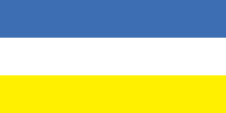
The flag of Hazarajat (Hazaristan), the homeland of the Hazara people (Hazara, Hazāra, Hasara, Hesoren, Hesoreh, Hazaras, Hazaralar), featuring three horizontal stripes in blue, white and yellow
Flag of the Hazarajat,
ratio = 1:2,
Source, by: Wikipedia (EN)


hoch/up


Coat of Arms


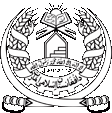
The coat of arms of Afghanistan, featuring a highly stylised mosque with an open Quran above it, set within a wreath of wheat ears and flanked by two crossed sabres
since 15.Aug.2021,
Coat of arms of Afghanistan,
Source: Falerístico, CC BY-SA 4.0, via Wikimedia Commons


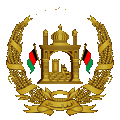
The coat of arms of Afghanistan, featuring a mosque surrounded by a wreath of wheat ears
2004–2021,
Coat of arms of Afghanistan,
Source, by: Bahij Virtual Academy [CC BY-SA 4.0], from Wikimedia Commons

hoch/up


Meaning/Origin of the Coat of Arms

The today's coat of arms of Afghanistan was introduced on 15th of August in 2021 after the Taliban militia regained power in Afghanistan. It shows in the colors black and white a wreath of ears between two crossed swords and in the middle a rising sun, an open Koran, a sermon pulpit, the name of the state, the year the state was founded and the Shahada, the Islamic creed, all in Arabic script. The to 15th of August in 2021 used coat of arms of Afghanistan showed, also before and for many years, an open mosque with prayer-niche and sermon pulpit, and on the outside of each side of the mosque stands, obliquely placed, a flag. The mosque was encircled by a bound wreath of grain ears, and since 1996, by the Shakhada as well.

Source: Nationalflaggen der Welt, Volker Preuß

hoch/up


Aircraft Roundel


Flugzeugkokarde Kokarde aircraft roundel Afghanistan
1924-1928,
Aircraft Roundel,
Source, by: Wikipedia (EN)


Flugzeugkokarde Kokarde aircraft roundel Afghanistan
1929–1965,
Aircraft Roundel,
Source, by: Wikipedia (EN)


Flugzeugkokarde Kokarde aircraft roundel Afghanistan
1965-1978,
Aircraft Roundel,
Source, by: Wikipedia (EN)


Flugzeugkokarde Kokarde aircraft roundel Afghanistan
1979–1983,
Aircraft Roundel,
Source, by: Wikipedia (EN)


Flugzeugkokarde Kokarde aircraft roundel Afghanistan
1983–1992,
Aircraft Roundel,
Source, by: Wikipedia (EN)


Flugzeugkokarde Kokarde aircraft roundel Afghanistan
1992-2002,
Aircraft Roundel,
Source, by: Wikipedia (EN)


Flugzeugkokarde Kokarde aircraft roundel Afghanistan
2002–2021,
Aircraft Roundel,
Source, by: Wikipedia (EN)

hoch/up


Map

Location:

Source: CIA World Factbook

Map of the country:

Source: CIA World Factbook

hoch/up


Numbers and Facts

Area: 252.071 square miles

Inhabitants: 34.941.000 (2018), thereof 40% Pashtuns, 27% Tadjiks, 9% Uzbeks, 9% Hazara

Religions: 99% Muslim (80% Sunni, 20% Shia)

Density of Population: 139 inh./sq.mi.

Capital: Kabul, 4.273.150 inh. (2020)

official Language: Pashtu, Dari (New Persian)

other Languages: Tadjik, Uzbek

Currency: 1 Afghani (Af, AFN) = 100 Puls

Time Zone: GMT + 4,5 h

Source: Wikipedia (D), World Statesmen

hoch/up


History

500/600 B.C. · Baktrian Empire

630 B.C. · Persian conquest

330 B.C. · Greek conquest

323 B.C. · to the empire of the Seleucides

3rd cent. · to the Persian empire of Sassanides

664 · Arabian conquest

977–1186 · empire of Ghaznavides

13th/14th cent. · Mongol invasion

16th cent. · to the Persian Empire of the Safavides

1747 · establishment of Afghanistan

1838–1842 · war against Great Britain

1878–1880 · war against Great Britain

1907 · British half-colony

9th of August 1919 · independence

1973 · fall of the monarchy

1979–1989 · occupied by troops of the Soviet Union

2001 · onset of the US-american occupation

2021 · end of the US-american occupation, seizure of power by the Taliban militia

Source: Atlas zur Geschichte, Wikipedia (D), World Statesmen

hoch/up


Origin of the Country's Name

"Afghanistan" literally means "Land of the Afghans". "Afghans" is the historical Persian name for the people of the Pashtuns, first mentioned in 1801, officially introduced in 1919. The Pashtuns with 60% are the majority within the population.

Source: Wikipedia (D)

hoch/up


Click here to go to the start page