This page is part of the project
www.flag-encyclopedia.com


zur deutschen Version, Flagge klicken oder tippen

Ethiopia


Contents

Flag

Historical Flags

Meaning/Origin of the Flag

Coat of Arms

Historical Coats of Arms

Meaning/Origin of the Coat of Arms

Aircraft Roundel

Map

Numbers and Facts

History

Origin of the Country's Name


Flag

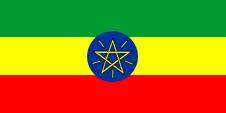
The flag of Ethiopia, shown here as the national, state and merchant flag, with three horizontal stripes in green, yellow and red and the Ethiopian coat of arms in the centre: a blue disc bearing a golden pentagram, the Seal of Solomon
National and state and merchant flag,
ratio = 1:2,
Source, by: Wikipedia (D)


hoch/up


Historical Flags

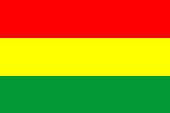
The flag of Ethiopia (Abyssinia) featuring three horizontal stripes in red, yellow and green
1897–1936,
National and state flag,
ratio = 2:3,
Source, by: Flags of the World


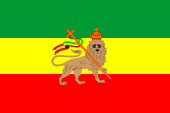
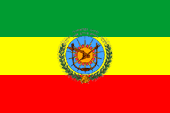
The flag of Ethiopia (Abyssinia), shown here as the national, state and merchant flag, featuring three horizontal stripes in green, yellow and red and the emblem of Ethiopia in the centre, the Lion of Judah
1941–1974,
National, state and merchant flag,
ratio = 2:3,
Source, by: Wikipedia (D),
FDRMRZUSA, Public domain, via Wikimedia Commons


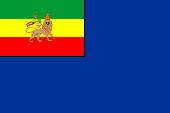
The flag of Ethiopia (Abyssinia), here the naval ensign, solid blue, with the national flag featuring three horizontal stripes in green, yellow and red in the upper corner, and the emblem of Ethiopia, the Lion of Judah, in the centre
1941–1974,
Naval flag,
ratio = 2:3,
Source, by: Flags of the World,
FDRMRZUSA, Public domain, via Wikimedia Commons


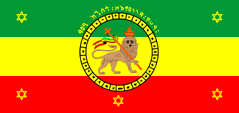
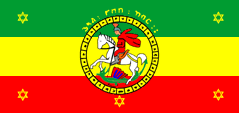
The flag of the Emperor of Ethiopia (Negus of Abyssinia), featuring three horizontal stripes in green, yellow and red, with a symbol in each corner combining a Star of David and a small Latin cross. In the centre of the front appears the Lion of Judah, surrounded by a circle of 32 segments each containing a Star of David with a cross, above it the motto 'The Victorious Lion of the Tribe of Judah', the traditional religious‑political title of the Solomonic dynasty
1941–1974,
Flag of the Emperor (front),
ratio = 45:95,
Source, by: Flags of the World,
FDRMRZUSA, Public domain, via Wikimedia Commons


The flag of the Emperor of Ethiopia (Negus of Abyssinia), featuring three horizontal stripes in green, yellow and red, with a symbol in each corner combining a Star of David and a small Latin cross. In the centre of the reverse side appears Saint George slaying the dragon, above it the motto 'Power–Star–Honour', a typical three‑part formula of Ethiopian Orthodox and imperial symbolism
1941–1974,
Flag of the Emperor (reverse),
ratio = 45:95,
Source, by: Flags of the World,
FDRMRZUSA, Public domain, via Wikimedia Commons


The flag of Ethiopia, shown here as the state flag from 1974 to 1987, featuring three horizontal stripes in green, yellow and red with the central emblem depicting a plough
1974–1987,
State flag,
ratio = 2:3,
Source, by: Flags of the World, Flaggen und Wappen


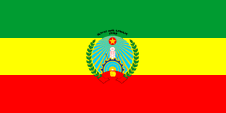
The flag of Ethiopia, shown here as the national flag from 1987 to 1991, featuring three horizontal stripes in green, yellow and red with the central emblem depicting the Obelisk of Axum
1987–1991,
State flag,
ratio = 1:2,
Source, by: Flags of the World


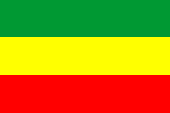
The flag of Ethiopia, shown here as the national flag and the merchant ensign, with three horizontal stripes in green, yellow and red
1941–1974,
National and merchant flag,
ratio = 2:3 / 1:2,
Source, by: Flags of the World


The flag of Ethiopia, shown here as the national flag and the merchant ensign, with three horizontal stripes in green, yellow and red
1974–1996,
National and merchant flag,
ratio = 1:2,
Source, by: Flags of the World


hoch/up


Meaning/Origin of the Flag

The today's flag of Ethiopia shows three horizontal stripes in green, yellow and red. In the center – above all – the coat of arms of the state, a blue disk with a thereupon lying down yellow pentagram. The green stands for the work and the fruitfulness of the land, the yellow for patriotism and justice, and red stands for bravery and the in the struggles for indpendence given blood.

The colors are also interpreted in a Christian way as a symbol of the Christian Trinity: Green stands for Holy Spirit, yellow stands for God the Father, and red for the son. The colors are also associated with Christian virtues. Green in this way hope, yellow represents charity and red stands for the faith.

The flag of Ethiopia was hoisted up for the first time – in inverted sequence of colors – in the year 1897. The colors of the flag have their roots in the trimming of the throne hall of emperor Menelik II. (1889–1913) with little pennants in this colors. From 1935 till 1941 Ethiopia was an Italian colony, and has not an own flag. After the retreat of the Italians follows the reintroduction, this time in the today usual sequence of the colors. In this form the flag stays unchanged, irrespective of the diverse coats of arms in the middle of the state flag, and is in the today's form official since the 6th of February in 1996.

The colors of the flag are even known as the "Panafrican colors": Perhaps in 1900 was the beginning of the Panafrica-Movement, wich wants to emphasize the commons of all people with black skin. The colour-triad green-yellow-red, wich used many african and even american countries in their flags after the independence, stands for the political unity of Africa, of all black People. The first country was Ghana in 1957. As the origin apply the colours of Ethiopia (Abessinia), the oldest independent state in Africa.

The Emperor’s flag, featured, like the national flag, three horizontal stripes in green, yellow and red, with a symbol in each corner combining a Star of David with a small Latin cross. In the centre of the flag, as on the national flag, appeared the Lion of Judah, but within a circle of 32 segments, each containing a Star of David with a cross. Above it appeared the motto: ሞአ፡አንበሣ፡ዘእምነገደ፡ይሁዳ (Mo’a Anbessa Ze’imnegede Yehuda – The Victorious Lion of the Tribe of Judah), the official, traditional, religious-political title of the Solomonic dynasty. The reverse side features a different image in the centre of the flag instead of the Lion of Judah: Saint George slaying the dragon. The motto above the circle reads: ኃይል፡ኮከብ፡ክብር፡፡ (Hayl:Kokäb:Kebr – Strength–Star–Glory), a three-part formula typical of Ethiopian Orthodox and Ethiopian imperial symbolism.

Source: Die Welt der Flaggen, Flaggen und Wappen, Flaggen Wappen Hymnen, Wikipedia (D), Volker Preuß

hoch/up


Coat of Arms


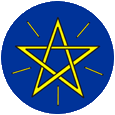
The coat of arms of Ethiopia, consisting of a blue disc bearing a golden depiction of a pentagram, the Seal of Solomon
since 1996,
Coat of arms of Ethiopia,
Source, by: Wikipedia (D)

hoch/up


Historical Coats of Arms


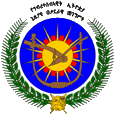
The coat of arms of Ethiopia, which features a plough in the centre
1974–1987,
Coat of arms of Ethiopia,
Source, by: Wikipedia (D)


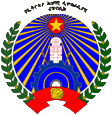
The coat of arms of Ethiopia, which features a cogwheel and the pillar of Aksum in the centre
1987–1991,
Coat of arms of Ethiopia,
Source, by: Wikipedia (D)

hoch/up


Meaning/Origin of the Coat of Arms

As coat of arms of the state Ethiopia was in use since older times the so named lion of Juda. That is probably borrowed from the Armenian lion and gets assumed. The lion of Juda was already in the middle ages valid as the scutcheon animal of the legendary priest Johannes. With the end of the monarchy was introduced a new coat of arms in 1975. It showed a large sun and a cogwheel (industry) on a blue disk, in front a plow (agriculture). This all was bordered with two oil-twigs. On this point, where both oil-twigs are crossing, appeared a medallion with the depiction of the lion of Juda.

With the acceptance of a new constitution was introduced a new coat of arms in 1987. This showed a depiction of the obelisk of Aksum, a large cogwheel, and a circular shield with behind situated arms, above that a red star. The coat of arms was surrounded by oil-twigs and palm tree fronds.

With the acceptance of a new constitution as federative democratic republic was introduced a new coat of arms on 6th of february in 1996, together with the resolution to use this on the national flag. It shows a blue disk with the golden depiction of a pentagram, the seal of Salomo. Between the five jags of the pentagram appear trapezoid beams. This symbol should shows the equality of all nationalities and religions by his regular construction, and at the same time portray the unity of the residents of Ethiopia. The golden beams stand for the future of the land.

Source: Die Welt der Flaggen, Flaggen und Wappen, Flaggen Wappen Hymnen

hoch/up


Aircraft Roundel


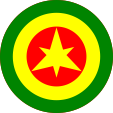
The aircraft roundel of the Ethiopian Empire, consisting of concentric circles in green, yellow and red, with a star in the centre
1941–1974,
Aircraft Roundel,
Source, by: Wikipedia (EN)


The aircraft roundel of Ethiopia, green, yellow and red, with a blue disc bearing a golden depiction of a pentagram, the Seal of Solomon
since 1996,
Aircraft Roundel,
Source, by: Wikipedia (EN)

hoch/up


Map

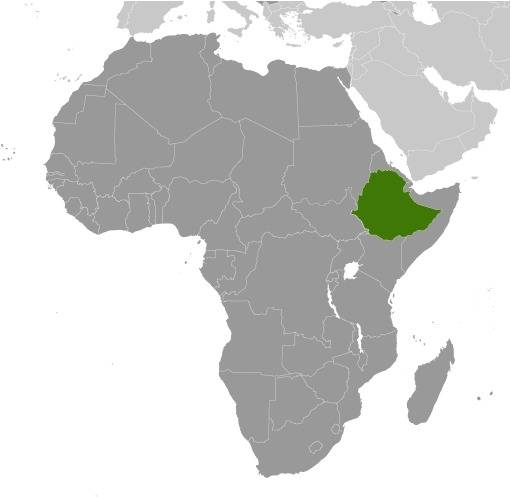
Location:

Source: CIA World Factbook

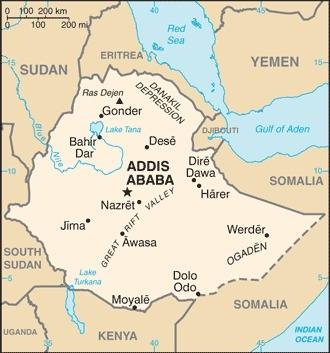
Map of the country:

Source: CIA World Factbook

hoch/up


Numbers and Facts

Area: 426.370 square miles

Inhabitants: 132.100.000 (2024), thereof 27% Amhara, 34% Oromo (Galla), 4% Sidama

Religions: 63% Christian (mostly Ethiopian Orthodox), 34% Muslim, 2% Animist

Density of Population: 310 inh./sq.mi.

Capital: Addis Abeba, 3.352.000 inh. (2016)

official Language: Amharic

other Languages: English

Currency: 1 Birr (ETB, Br) = 100 Santim

Time Zone: GMT + 3 h

Source: Wikipedia (D)

hoch/up


History

From around 3 million years ago · Earliest hominids (including Lucy and Selam) in present-day Ethiopia

From the 1st millennium BC · Emergence of early states in the north

1st–7th centuries AD · The Aksumite Empire, one of the great empires of late antiquity; early Christianisation (4th century)

7th–13th centuries · Isolation of Ethiopian Christianity due to Islamic Expansion

13th to 18th cent. · first empire

from the 14th century · Closer contacts with Europe; attempts to form alliances against Muslim sultanates

1543 · Portuguese troops assist Ethiopia against the Sultanate of Adal

1855 · second empire

1868 · British expedition to Ethiopia against Emperor Tewodros II

Late 19th century · Italian colonial ambitions

1896 · Battle of Adwa: Ethiopia defeats Italy and remains independent (alongside Liberia, the only non-colonised state in Africa)

1931 · First constitution

1935–1941 · Italian invasion and occupation (War of Abyssinia), widespread use of poison gas, Ethiopia becomes an Italian colony, though Italy’s sphere of influence is limited

1941 · Liberation by British and Ethiopian troops; return of Haile Selassie

1955 · Introduction of women’s suffrage

1973–1974 · Economic crisis, drought, unrest

1974 · Overthrow of Haile Selassie, end of the monarchy, end of the Solomonic dynasty

1974–1991 · Socialist military regime (Derg) under Mengistu Haile Mariam

1977–1978 · Ogaden War against Somalia

1984–1985 · Great famine (up to 1 million deaths)

1991 · Fall of the Derg; EPRDF takes power

1993 · Eritrea gains independence

1995 · New constitution; Ethiopia becomes a federal republic (‘ethnic federalism’)

1998–2000 · Border war with Eritrea

From 2005 · Strong economic growth

2018 · Prime Minister Abiy Ahmed; peace agreement with Eritrea

2019 · Abiy awarded the Nobel Peace Prize

2020–2022 · Civil war in Tigray (hundreds of thousands of deaths)

2023 · State of emergency in Amhara due to new conflicts

Source: Atlas zur Geschichte, Wikipedia (D)

hoch/up


Origin of the Country's Name

The name of the country goes back to the ancient Greek name "aithiops", which means "burnt face", and referred to the dark-skinned inhabitants of Africa.

Source: Handbuch der geographischen Namen

hoch/up


Click here to go to the start page