This page is part of the project
www.flag-encyclopedia.com


zur deutschen Version, Flagge klicken oder tippen

Equatorial Guinea


Contents

Flags

historical Flag

Meaning/Origin of the Flag

Coat of Arms

Meaning/Origin of the Coat of Arms

Aircraft Roundel

Map

Numbers and Facts

History

Origin of the Country's Name


Flags

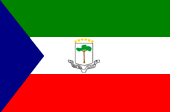
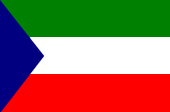
The flag of Equatorial Guinea, as national flag, state flag and naval flag, with three horizontal stripes in green, white and red and a flat blue triangle at the hoist
National, state and naval flag,
ratio = 2:3,
Source, by: Corel Draw 4, Wikipedia (D)


The flag of Equatorial Guinea, as national flag, state flag and naval flag, with three horizontal stripes in green, white and red and a flat blue triangle at the hoist
National, state and naval flag,
Variant without coat of arms,
Source, by: Corel Draw 4, Wikipedia (D)


hoch/up


historical Flag

The flag of Equatorial Guinea, as national flag, state flag and naval flag, with three horizontal stripes in green, white and red and a flat blue triangle at the hoist
1968–1973,
National, state and naval flag,
Source, by: Corel Draw 4, Wikipedia (ES)


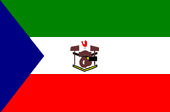
The flag of Equatorial Guinea between 1973 and 1979, during the rule of Macías Nguema, as national flag, state flag and naval flag, with three horizontal stripes in green, white and red, a flat blue triangle at the hoist and the period‑specific coat of arms in the centre: two crossed tools, a tree and the slogan 'Unity, Peace, Justice'
1973–1979,
National, state and naval flag,
Source, by: Flags of the World


hoch/up


Meaning/Origin of the Flag

The flag of Equatorial Guinea consists of three horizontal stripes in green, white and red, with a flat blue triangle at the hoist, and the country’s coat of arms in the centre of the white stripe. In this form, it is used as the national flag, the state flag and the naval ensign. The flag was adopted on 12th of October in 1968 to mark independence from Spain. As there were no regulations governing its use until 1973, the flag was usually flown without the coat of arms. Green symbolises the country’s natural resources, agriculture and the jungle. Blue symbolises the sea, which connects the mainland with the islands. White symbolises peace. Red symbolises the bloodshed of the independence fighters. The tree that appears on the national flag and in the coat of arms is the cotton-silk tree.

Source: Die Welt der Flaggen, Flaggen Wappen Hymnen, Wikipedia (ES)

hoch/up


Coat of Arms


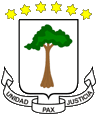
The coat of arms of Equatorial Guinea, a white shield with a tree in it, six golden stars above it and a banner below it
Coat of arms of Equatorial Guinea,
Source, by: Corel Draw 4, Wikipedia (D)

hoch/up


Meaning/Origin of the Coat of Arms

In the arms is to see a mangrove-tree on a silver shield, over there are six golden six-jaged stars jag. By other sources should the tree allegedly be a cotton-silk tree, under which in the middle og the nineteenth century the Spanish and king Bonkoro of Bata came to their first agreement. The six stars above the shield symbolize the mainland and the five islands of the country. Beneath the shield the inscription: "Unity, Peace, Justice". Between 1973 and 1979, in the time of the rule of Macia Nguema, was used an other coat of arms.

Source: Die Welt der Flaggen, Flaggen Wappen Hymnen

hoch/up


Aircraft Roundel


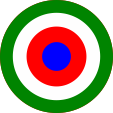
The aircraft roundel of Equatorial Guinea, concentric circles in the four colours of the flag
Aircraft Roundel,
Source, by: Wikipedia (EN)

hoch/up


Map

Location:

Source: CIA World Factbook

Map of the country:

Source: CIA World Factbook

hoch/up


Numbers and Facts

Area: 10.830 square miles, thereof Mainland Mbini (Rio Muni) ca. 10.038 sq.mi., Bioko Island 779 sq.mi., Annobón Island 7 sq.mi.

Inhabitants: 1.670.000 (2022)

Religions: 87% Roman Catholic, 5% Protestant

Density of Population: 154 inh./sq.mi.

Capital (since 2nd of January in 2026): Ciudad de la Paz

Capital (to 1st of January in 2026): Malabo (name to 1973: Santa Isabel), 297.000 inh. (2018)

official Languages: Spanish, French and Portuguese

Currency: CFA-Franc (BEAC) = 100 Céntimes

Time Zone: GMT + 1 h

Source: Wikipedia (D)

hoch/up


History

ca. 1500 · Portugal takes possession of the present-day territory under the name Fernando Póo

1778 · Cession of the colony from Portugal to Spain

1843 · Conquest of the mainland by Spain

From 1926 · Start of the systematic colonisation of the mainland (Río Muni) by Spain

1963 · Introduction of internal autonomy by Spain under the name Equatorial Guinea

29 July 1968 · Independence from Spain; election of Francisco Macías Nguema as president

1969 · Elimination of political rivals by Macías; start of a reign of terror

1973 · New constitution; unification of the provinces into a unitary state

1975 · Mass executions by the Macías regime; massive exodus

1979 · Overthrow and execution of Macías by Teodoro Obiang; military takeover

1987 · Founding of the ruling party PDGE by Obiang; start of one-party rule

1991 · New constitution; formal multi-party system, real control by the president and the PDGE

1996–2016 · Repeated elections with lopsided results in favour of Obiang; allegations of manipulation

2014 · Full membership of the Community of Portuguese-Speaking Countries (CPLP)

2016 · Appointment of Teodorín Obiang as Vice-President; preparations for dynastic succession

2026 · Ciudad de la Paz becomes the new capital by decree

Source: Atlas zur Geschichte, Wikipedia (D)

hoch/up


Origin of the Country's Name

The name "Guinea" described earlier the entire west coast of Africa between Cape Dakar and Cape Lopez. It goes back to the name "aguinaou", a word of the Tuareg, to describe peoples south of the Sahara: "Blacks".

Source: Handbuch der geographischen Namen

hoch/up


Click here to go to the start page