zur deutschen Version, Flagge klicken oder tippen

- historical region in France
- former county and province
- own names:
Flemish: Artesië, French: Artois, German: Artesien
• Flag
• Meaning/Origin of the Flag
• Coat of Arms
• Meaning/Origin of the Coat of Arms
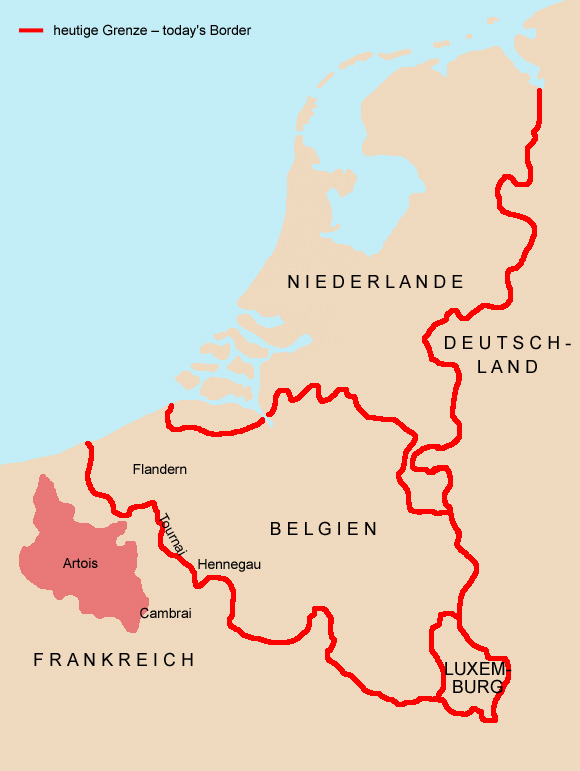
• Map of Artois
• Map of the historical Regions in France
• Explanations about the Regions
• Numbers and Facts
• History
• Origin of the Country's Name
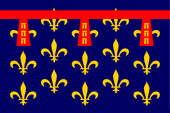
Flag of Artois,
Source, by:
Die Welt der Flaggen


The flag of Artois is a scutcheon-flag, it shows the image of the coat of arms. Its design has its roots in the year 1237, when the country became a county of the Capetians.
Source:
Volker Preuß
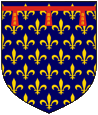
1237–1384,
Coat of arms of Artois – Armoriaux de Artois,
Source, by:
Wikipedia (D)
When King Louis IX. of France in 1237, the county of Artois established again, he transferred it to his younger brother Robert. Ludwig and Robert are both sons of King Louis VIII., the Lion, and Blanche of Castile, so children of the compound of the dynasties of France and Castile. Therefore was created, a coat of arms for Robert, as the Count of Artois, which combined the heraldry of the Capetians of France with the heraldry of Castile. Thus the coat of arms of the Capetian was supplemented with a red tournament collar, which featured Robert as a younger son (following the rules of the French heraldry), and on its flaps appeared per three times a golden castle, the symbol of Castile. The coat of arms of the Capetians showed three golden lilies on blue, but originally was the coat of arms sprinkled with lilies. From 1365 (by others sources 1376), the number of lilies was reduced to three. The lily-symbol is very old, already the Germanic tribe of the Franks has used it.
Source:
Lexikon der Heraldik,
Volker Preuß,
Wikipedia (D)
Source: Volker Preuß
The historical, French Regions:

in black: governorate and province in 1776,
in red: former county, province oder governorate
Map: Volker Preuß
The provinces (or governorates) that existed until the French Revolution were historically grown entities that had often developed from former fiefdoms of the French crown, historical counties and duchies, often existed for hundreds of years and had preserved regional characteristics (cultural peculiarities and regional languages). Such phenomena were naturally undesirable to the French Revolution, and in the context of its bloody and violent egalitarianism, all regional references were eradicated. Shortly after the Revolution, the provinces were dissolved and France was divided into many small départements, which were to be approximately the same size and have the same status, controlled by prefects of the central administration in Paris. The departments were named after rivers or mountains so as not to use the names of any of the old provinces. However, it was not possible to sever the ties between the inhabitants of France and their respective historically grown regions, so that in 1960 regions were created again. There can hardly be said to be any real autonomy. The regions are only supposed to promote the economic, social, health, cultural and scientific development of the region, keep an eye on housing and living conditions, and provide support in some areas, e.g. urban development policy, urban regeneration, regional planning, preservation of regional identity and promotion of regional languages. When the regions were formed, departments located in a particular historical province were administratively grouped together into a region that often had the same historical name. The resulting entities only roughly corresponded to the boundaries of historical provinces. In strictly centralised France, however, any form of responsible regionalism is avoided. The regions do not even have their own seals with which to mark their own legally binding decisions, because there are no plans to introduce such a thing. Therefore, anything to do with coats of arms or flags is completely irrelevant. The logos of the regions are used generally, sometimes with the colours reversed and placed arbitrarily on flags or banners. There are no rules, as they are not official symbols. The logos and flags of the regions therefore often look like company logos: Unloving, unhistorical, technocratic and modernistic. That is why most of these regions have a kind of unofficial heraldic flag, which is intended to recall historical heraldic models. However, these are merely decorative in nature and are not a symbol of sovereign functions. The regions created in 1960 were even called into question in 2014, and a territorial reform was decided – centrally from Paris – which reduced the number of regions by almost half through mergers. The regions and their institutions were not even consulted on this matter.
Wikipedia Link to the regions of France:
click or tap here
FOTW Link to the regions of France:
click or tap here
Source: Flags of the World,
Wikipedia (D),
Volker Preuß
The historical province of Artois today belongs to the region of Nord-Pas-de-Calais.
The Province:
Area: 1.186 sq.mi.
Inhabitants: 1.110.000 (2008)
Density of Population: 585 inh./sq.mi.
Capital: Arras, 41.600 inh. (2010)
official Language: French
Time Zone: GMT + 1 h
Source:
Wikipedia (FR)
antiquity · settlement by the Celtic tribe of the Atrebates
55 B.C. · Roman conquest
5th century A.D. · conquest and settlement by the Franks
481–863 · to the Frankish Empire, establish of the county of Arras (Atrecht, Artois)
863 · Judith, daughter of Charles the Bald, marries Baldwin Iron Arm the Count of Flanders, Artois comes as a dowry to the County of Flanders
880 · Treaty of Verdun and Ribbemont, at the division of the Frankish Empire comes Flanders (Westflanders, Crown Flanders) to the West Frankish Kingdom (France)
1180 · Isabella of Hainault , niece of Philip, Count of Flanders, marries Philip II Augustus, King of France, Artois comes as a dowry to France
1237 · King Louis IX . of France re-establishes the County of Artois , and hands it over it to his younger brother Robert, as Robert I. Count of Artois, founder of the line France-Artois
1384 · Artois comes through marriage to the Duchy of Burgundy
1477 · death of Charles the Bold, Duke of Burgundy, in the following years succession disputes
1482 · Peace of Arras, Artois comes to France
1493 · Peace of Senlis , Artois comes as a dowry for Margaret of Austria (daughter of Emperor Maximilian) to the House of Habsburg, becomes in this way a part of the Habsburg Netherlands, and a part of the German Empire too
1526 · Peace of Madrid, the French king Francis I. renounces Flanders and Artois
1529 · Peace of Cambrai , the French king Francis I. renounces Flanders and Artois
1559 · Peace of Câteau-Cambresis, the French King Henry II. renounces Flanders and Artois
1643 · Thirty Years' War, France conquers parts of Artois and the the capital Arras
1659 · Pyrenean Peace, Habsburg has to cede Artois to France, however Artois is equipped with some special rights of a estates state, what could be an own estates assembly (a kind of parliament) or may even mean an own tax jurisdiction towards the king
1776 · the already in the 14th century created governorates of the civil administration of the kingdom of France become committed to a number of 39, and correspond in this way to the number of provinces, in previous years could any provinces be summarized in one governorate
1789 · on the occasion of the French Revolution the estates-state of Artois and its respective privileges were abolished and the entire region was divided into two departments (Pas-de-Calais und Somme)
1960 · reintroduction of regions in France, Artois doesn't play a role, forming of the Nord-Pas-de-Calais region, of course not within the historic boundaries, just by integrating of the departments of Nord und Pas-de-Calais
2016 · the Nord-Pas-de-Calais region merges with the Picardy region in the new, larger region of Hauts-de-France
Source:
Wikipedia (D),
Brockhaus Konversationslexikon
The name of the Country "Artois" and also of its capital "Arras" (German: Atrecht) goes back to the Celtic tribe of the "Atrebates", who settled here at the time of Roman rule. The Latin name of the country was "Artesia", the source of the "Artesian Wells", which were built first here in 1126.
Source:
Handbuch der geographischen Namen,
Volker Preuß