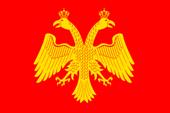
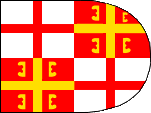
The symbol of the Byzantine Empire was a golden double-headed eagle on a red background. This symbol became widely used as the imperial flag from the 11th century onwards. The choice of red and gold is easily explained: they are the colours of the city of Rome and the Roman Empire, which helps to explain why the Byzantine Empire was commonly referred to as the 'Second Rome' or 'Eastern Roman Empire'. In practice, the flag bearing the eagle was often supplemented with additional symbols, such as the emblems of the ruling dynasty or Christograms. The eagle was also sometimes depicted within a golden circle. In times of war, the eagle was reportedly depicted in black on a red background. The emperors of the Palaiologos dynasty also had personal standards. Some sources mention, alongside the red eagle flag, a golden standard featuring a black eagle. The form of the eagle was not regulated, but the eagle with a sword and imperial orb (globe) is likely to represent a later form used by the Orthodox Church (compare Athos, Hagion Oros). One standard displayed the symbolism of the ruling dynasty. These were the Palaiologos. Their standard combined the Cross of St. George with a golden cross, the corners of which feature four flint stones. This symbol is still used by Serbia today and probably has its origins in the heraldry of the Order of the Golden Fleece; it could also represent the Greek letter 'B' four times, which can be interpreted as 'Baleologs', or the Greek letter 'V' four times, as the initials of the Greek phrase: Βασιλευς Βασιλεων Βασιλευων Βασιλευσιν (Vasilevs Vasileon Vasilevon Vasilevsin → "King of Kings, ruling over kings"). Overall, it is difficult to fit the flags and banners of the Byzantine Empire into a modern flag system. There were simply no regulations as we know them today.
395 · partition of the Roman Empire into East Roman and West Roman Empire
399–401 · repulse of the Gotes
531–562 · war against the Persian Empire
533–534 · conquest of the Wandalic Empire
535–554 · conquest of the East Gotic Empire
568 · loss of upper Italy to the Langobardes
627 · victorious war against the Persian Empire
642–643 · Arabian invades
718 · repulse of the Arabs
1081–1185 · repulse of the Petscheneges
1204–1261 · Latin Empire of Konstantinopel, therewith shattering of Byzanz into the Empire of Nicaea, the Empire of Trebizond and the Despotate of Epirus
1261 · re-conquest of Konstantinopel
1453 · conquest of Konstantinopel by the Turks (Ottoman Empire)
The country can be found in historiography under many names: Byzantine Empire, Byzantium, Eastern Rome, East Roman Empire, Eastern Roman Empire, Romëic Empire, Byzantine Empire. The name of the country goes back to the partition of the Roman Empire in 395 into an Eastern Roman and a Western Roman Empire. Even this country's name goes back to a locality, the city of Rome. The Western Roman Empire fell relatively quickly, in 476 with the deposition of the last Roman emperor Romulus Augustulus, and in 486 with the fall of the Empire of Syagrius as the last Roman governor. The Eastern Roman Empire still existed for many centuries and because the Roman Empire with Western Rome had almost perished, the capital of the Eastern Roman Empire – Byzantium – became the center of the Roman world, as the proverbial Second Rome. This is also to see in the self-image of the country, which called itself Basileía Rhōmaíōn (Imperium Romanum), in the local language Greek. The inhabitants did not see themselves as Greeks either, but as "Romëans", i.e. Romans. Some historians, chroniclers and contemporary witnesses also named the country after the capital, where the name Byzantine Empire comes from, even if the city was renamed in "Constantinopolis" in the year 337, after the death of Emperor Constantine. The name Constantinople was retained for the city until it was conquered by the Turks in 1453, who renamed the city in "Istānbūl", even though "Kostantiniyye" was still used during a transitional period.