This page is part of the project
www.flag-encyclopedia.com


zur deutschen Version, Flagge klicken oder tippen

Egypt


Contents

Flags

historical Flags

Meaning/Origin of the Flag

Coat of Arms

historical Coats of Arms

Meaning/Origin of the Coat of Arms

Aircraft Roundel

Map

Numbers and Facts

History

Origin of the Country's Name


Flags

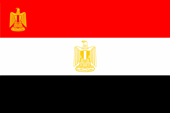
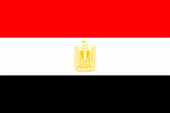
The national flag, state flag, and merchant flag of Egypt (own name: Misr), with three horizontal stripes in red, white, and black, with the country's coat of arms in the center
National, state and merchant flag,
ratio = 2:3,
Source, by: Wikipedia (D)


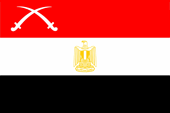
The war flag and flag of the army of Egypt (own name: Misr), with three horizontal stripes in red, white, and black, with the country's coat of arms in the Center and two crossed swords in the upper corner
War flag and flag of the army,
Source, by: Flags of the World


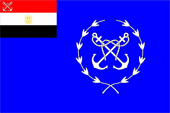
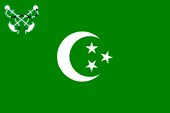
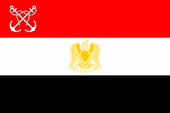
The naval flag of Egypt (own name: Misr), plain blue, with the flag of Egypt in the upper corner and two crossed anchors in a wreath at the flying end of the flag
Naval flag,
ratio = 2:3,
Source, by: Flags of the World


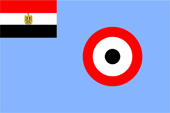
The flag of the Egyptian Air Force (proper name: Misr), plain light blue, with the Egyptian Air Force cockade in the centre
Flag of the Air Force,
ratio = 2:3,
Source, by: Flags of the World


The flag of the President of Egypt (proper name: Misr), like the national flag, but with the national coat of arms in the upper corner
Flag of the President,
ratio = 2:3,
Source, by: Wikipedia (D), www.tahyamisr.net


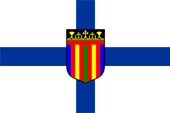
The flag of the Coptic Christians in Egypt, white with a blue cross, running across it, and a coloured coat of arms in the centre
Flag of the Copt Christs,
ratio = 2:3,
Source, by: Wikipedia (EN)


hoch/up


historical Flags

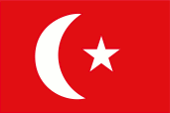
The flag of the Ottoman Empire, plain red with a white crescent and star in the center
ca. 1793–1844,
Flag of the Ottoman Empire,
Source, by: Flags of the World


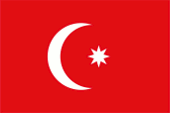
The flag of the Ottoman Empire, plain red with a white crescent and star in the center
1844–1914,
Flag of the Ottoman Empire,
Source, by: Flags of the World


The flag of the Sultanate of Egypt, plain red, with a triple crescent and star in white at the flagpole
1844–1914,
Flag of the Sultanate of Egypt,
Source, by: Flags of the World


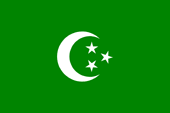
The flag or banner of the Kingdom of Egypt, plain green, with a crescent moon and three stars in white in the centre
1922–1958,
Flag of the Kingdom of Egypt,
Source, by: Flags of the World


The naval flag of the Kingdom of Egypt, plain green, with a crescent moon and three stars in white in the centre and additionally two crossed anchors in the upper corner
1922–1958,
Naval flag of the Kingdom of Egypt,
Source, by: Flags of the World


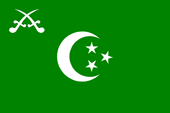
The flag of the Army of the Kingdom of Egypt, plain green, with a crescent moon and three stars in white in the centre and additionally two crossed swords in the upper corner
1922–1958,
Flag of the Egypt Army,
Source, by: Flags of the World


The flag of the Air Force of the Kingdom of Egypt, plain light blue, with the green national flag in the upper corner and the Air Force cockade in the centre of the flying part of the flag
1922–1958,
Flag of the Egypt Air Force,
Source, by: Flags of the World


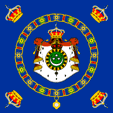
The flag (standard) of the King of Egypt at sea, square and plain blue, with the coat of arms of the country in the centre and a crown in each corner
1922–1952,
Standard of the King of Egypt at sea,
Source, by: Flags of the World


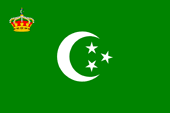
The flag or banner of the Kingdom of Egypt, like the national flag, plain green, with a crescent moon and three stars in white in the centre and a crown in the top corner
1922–1952,
Standard of the King of Egypt ashore,
Source, by: Flags of the World


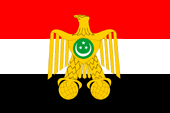
The Arab Liberation Flag, with three horizontal stripes in red, white and black, with Saladin's eagle in the centre
1952–1958,
Arab freedom flag,
Source, by: Flags of the World


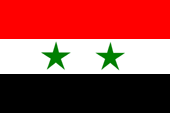
The flag of Egypt as part of the United Arab Republic, with three horizontal stripes in red, white and black, with two green stars in the centre of the white stripe
1958–1972,
Flag of Egypt as a part of the United Arab Republic,
(Abbreviation: VAR [UAR], the political union of Egypt and Syria 1958–1961),
Source, by: Flags of the World


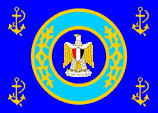
The flag (standard) of the President of Egypt at sea, plain blue, with the country's coat of arms in the centre and an anchor in each corner
1958–1972,
Flag of the President at sea,
ratio = 5:7,
Source, by: Flags of the World


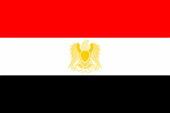
The national flag, state flag, and merchant flag of Egypt (own name: Misr), with three horizontal stripes in red, white, and black, with the country's coat of arms in the center
1972–1984,
National- und Merchant flag,
ratio = 2:3,
Source, by: Flaggen und Wappen


The naval flag of Egypt, with three horizontal stripes in red, white and black, with the country's coat of arms in the centre and two crossed anchors in the upper corner
1972–1984,
Naval flag,
ratio = 2:3,
Source, by: Flaggen und Wappen


hoch/up


Meaning/Origin of the Flag

The today's flag of Egypt shows three horizontal, same wide stripes in red, white and black with the golden (yellow) Eagle of Saladin, and was hoisted up in her today's form on 4th of October in 1984. The styling of the flag goes back to the after the abolition of the monarchy in the year 1952 introduced Arabic liberation flag. The eagle in the today's flag is, how in the Arabic liberation flag, too, the of the sultan Saladin and his descendants, the Aijubide-Kalifs, and is an idol-figure of the Arabian unity, too. He sustains today a breast shield, which is colored in the colors of the flag, and holds a font-ribbon with the name of the state in it's claws. Specially for Egypt the colors have the following meaning, too: red remembers the fights in the revolution abd the thereby given blood, white stands for a shining future and black for the dark past.

The colour triad of red, white and black is referred as Panarabian colours. This is not entirely correct. The three colours go back to the late Gamal Abd el-Nasser (1918–1970), Egyptian military officer, politician as well as later the state's president and prime minister, and most important representative of the Arabian nationalism and panarabism. After the national revolution of 1952 the Arabian Liberation Flag was introduced in Egypt, which represented those ideals. It was, at least in choice and arrangement a model for many other Arabian states and state alliances. The colours stand always for the revolution (red), the future (white) and the past (black). The colours have their roots in the flag of the Arabian Revolt during the First World War. Yet the colours of the Arabian Revolt (Arabian Movement) include even green.

The colour quartet of four, green, white, black and red is a special Arabian colours symbol, the Panarabian colours. The (Pan)Arabian colours were officially introduced by the Sheriff Hussein of Mekka – of the lineage of the Hashemides – as colours of the Arabian Movement during the First World War at the secession of the Kingdom of Hedjas from the Ottoman Empire. The flag of Hedjas served as pattern. The colours have the following meaning: Red is the colour of Omar, the second calif; white stands for the Omajiades, a calif-dynasty, which goes back to the fifth calif Moawija I.; green stands for the Fatimides, a ismailitic-shiit calif-dynasty, which goes back to the fourth calif Ali; and black stands for the Abbasides, a calif-dynasty, which goes back to the calif Abbas I. Red is also the colour of the Hashemides, an Arabian sovereign-dynasty, which probably goes back to Hashim ibn Abd al-Manaf, the grandfather of Mohammed. Green is in addition generally the colour of Islam, and does not refer only to the Arabian countries.

The flag history of Egypt: The flag of the Turkish vice kingdom of Egypt (1867-1882) is clearly from Turkish origin, how it is to see in the coloration and the symbols. The flag of the Kingdom of Egypt goes back to the islamic green, but the islamic symbolism remembers even slightly the Turkish times. The green should remind the fruitful Nile delta, too. This flag was in use till 1958, so as well after the end of the kingdom (1952). The flag of the UAR (1958-1961) shows three stripes in red, white and black, which were already officially introduced in Egypt in 1952, with the introduction of the Arabic liberation flag, completed by two stars, from them the one stands for Egypt and the other for Syria. Even after the end of the UAR (1961) Egypt maintaines this flag till 1972. In context with the formation of the "Federation of Arabic republics" between Libya, Egypt and Syria in the year 1972, was arranged, that these three states have to use red-black-white flags, which show in the center a golden hawk. The only difference should be the name of the respective state in the font ribbon, which holds the hawk in his claws. Egypt introduced such a flag in 1972, and maintained her until 1984 (Libya until 1977, Syria until 1980).

Source: Flags of the World, Wikipedia (D), Die Welt der Flaggen, Flaggen und Wappen, Flaggen Wappen Hymnen

hoch/up


Coat of Arms


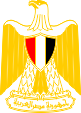
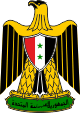
The coat of arms of Egypt, as Saladin's golden eagle
since 1984,
Coat of arms of Egypt,
Source, by: Wikipedia (D), Corel Draw 4


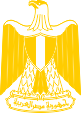
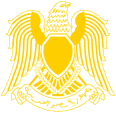
The coat of arms of Egypt, as Saladin's golden eagle
Coat of arms of Egypt on the flag,
Source, by: Wikipedia (D), Corel Draw 4

hoch/up


historical Coats of Arms


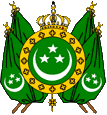
The coat of arms of the Kingdom of Egypt
1922–1958,
Coat of arms of the Kingdom Egypt,
Source, by: Der neue Brockhaus


The coat of arms of Egypt, as Saladin's eagle
1958–1972,
Coat of arms of Egypt,
Source, by: Wikipedia (D), Corel Draw 4


The coat of arms of Egypt, as Saladin's golden Falkon of the Quraysh
1972–1984,
Coat of arms of Egypt,
Source, by: Wikipedia (D), Corel Draw 4

hoch/up


Meaning/Origin of the Coat of Arms

The today's coat of arms of egypt is the symbol of the sultan Saladin and his descendants, the Aijubide's Kalifs, and is an idol-figure of the Arabian unity, too. He sustains today a breast shield, which is colored in the colors of the flag, and holds a font-ribbon with the name of the state in it's claws.

Source: Die Welt der Flaggen, Flaggen Wappen Hymnen,

hoch/up


Aircraft Roundel


The aircraft roundel of Egypt
1945–1958,
Aircraft Roundel,
Source, by: Wikipedia (EN)


The aircraft roundel of Egypt
1958–1972,
Aircraft Roundel,
Source, by: Wikipedia (EN)


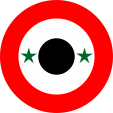
The aircraft roundel of Egypt
since 1972,
Aircraft Roundel,
Source, by: Wikipedia (EN)

hoch/up


Map

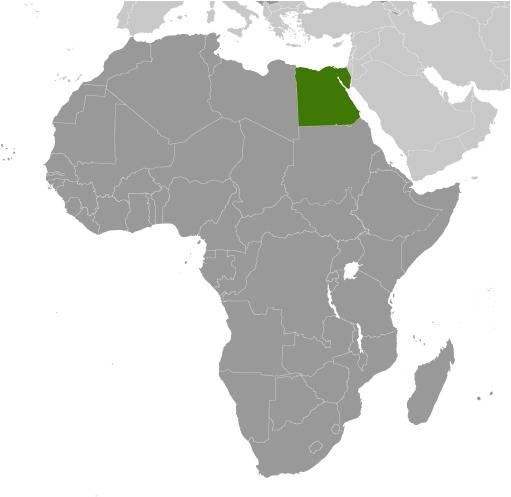
Position:

Source: CIA World Factbook

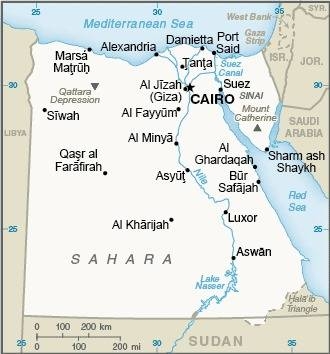
Map of the country:

Source: CIA World Factbook

hoch/up


Numbers and Facts

Area: 386.659 square miles

Inhabitants: 98.423.600 (2018)

Religions: 90% Muslim, 10% Christian (mostly Copts)

Density of Population: 255 inh./sq.mi.

Capital: Cairo (Al-Quahirah), 9.153.000 inh. (2017)

official Language: Arabian

Currency: 1 Egyptian Pound = 100 Piasters = 1 000 Milliemes

Time Zone: GMT + 2 h

Source: Wikipedia (D)

hoch/up


History

3000 to 800 B.C. · ancient Egypt

525 B.C. · Persian conquest

332 B.C. · Greek conquest

30 B.C. · Roman conquest

640 · Arabic conquest

1517 · Turkish conquest

1805 · Turkish vice kingdom

1882 · British conquest

1914 · end of the vice kingdom

1922 · independence as kingdom

1952 · end of monarchy

Source: Wikipedia (D), World Statesmen

hoch/up


Origin of the Country's Name

The name "Egypt" comes from the ancient second name of the city of Memphis. This was "Hutkaptah","Shrine of the god Ptah". Sometimes is also the Greek word "aigyptos", "dark" tryed to be compliant, but it is a coincidence. The ancient Egyptians called their land "Kemet," "The Black Land". The today's Arab-Egyptians call it "Misr".

Source: Handbuch der geographischen Namen

hoch/up


Click here to go to the start page